



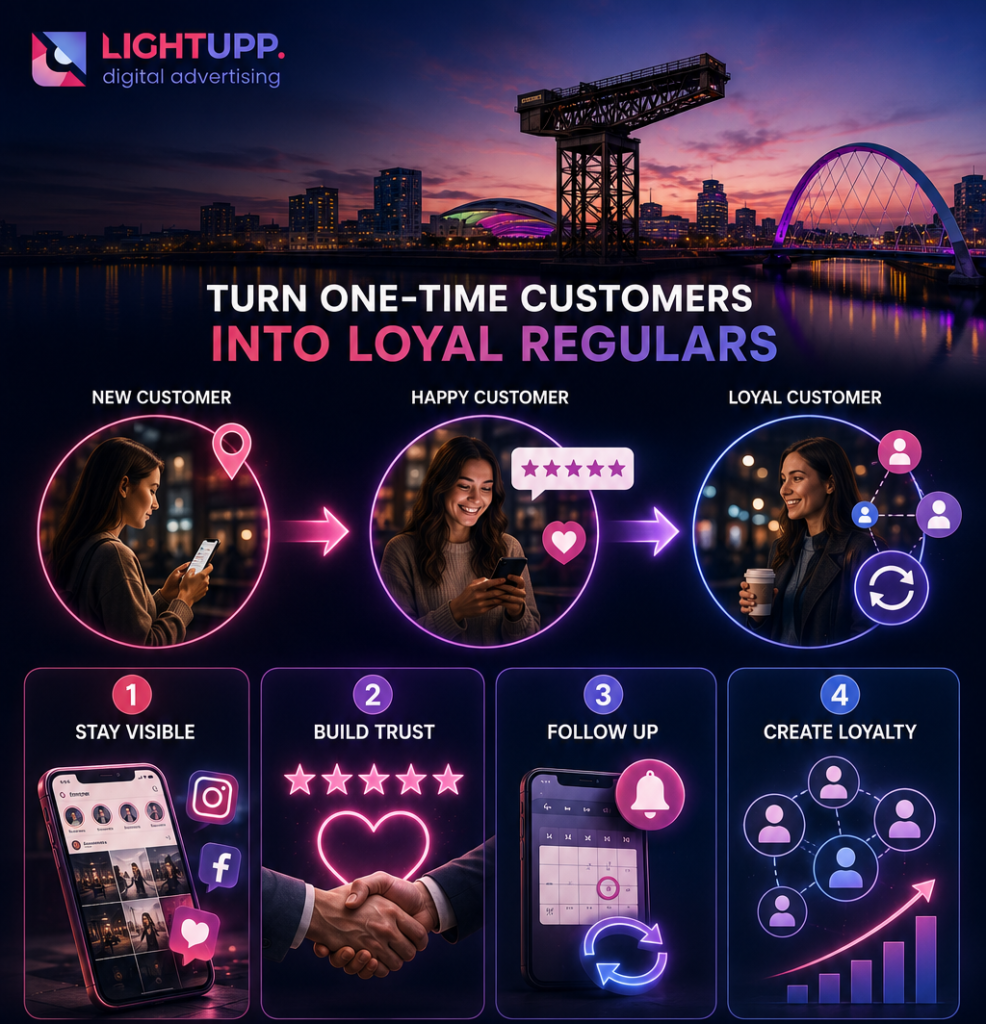
Almost all marketing energy goes into finding new customers. It’s the visible, exciting part – the ads, the social posts, the enquiries coming in. But there’s a quieter opportunity most businesses walk straight past: the customers they’ve already won and then forgotten. Someone who has already bought from you, already trusts you, and already knows where you are is far cheaper to sell to again than a stranger is to convince from scratch. This guide is about that overlooked half of the equation – how Glasgow businesses turn a one-off purchase into an ongoing relationship, without gimmicks or a loyalty-card scheme nobody uses.
Why Retention Beats Acquisition
The economics are lopsided, and once you see them they’re hard to unsee. Winning a new customer means competing for attention, building trust from zero, and usually paying for the privilege. Selling again to an existing one skips all three.
- They already know and trust you – the hardest work is done
- You don’t pay again to reach them the way you do a stranger
- They spend more over time as the relationship builds
- They tell other people, becoming a source of new customers themselves
- They forgive the occasional off day that would lose a first-timer
None of this argues against finding new customers – you need both. The point is that most businesses do one and neglect the other entirely, which means they’re constantly refilling a leaking bucket instead of also patching the leak.
Why Customers Don’t Come Back (And It’s Usually Not Price)
The assumption is that people leave for a cheaper option. Occasionally true, but the research on this consistently points elsewhere: most customers drift away not because of a competitor, but because they felt forgotten. There was no reason to come back and nothing reminded them to.
- They simply forgot you existed – out of sight, out of mind
- Nothing prompted a return visit at the right moment
- The first experience was fine but unmemorable, so nothing stuck
- A small niggle went unresolved and quietly put them off
- They never felt like anything more than a transaction
The encouraging implication: if people leave mainly through neglect rather than active dissatisfaction, retention is largely within your control. It’s about staying present and giving people a reason, not about being the cheapest.
The Foundations: Get These Right First
A first experience worth repeating
Nothing else on this list matters if the first interaction wasn’t good enough to warrant a second. Before working on retention tactics, be honest about whether the core experience – the product, the service, the way people are treated – is genuinely worth coming back for. If it isn’t, fix that first; no amount of follow-up rescues a weak first impression.
A reason to return
Some businesses have natural repeat cycles – a café, a barber, a garage. Others have to create a reason: a new range, a seasonal offer, a service that complements the first purchase. If there’s no obvious reason for someone to come back, that’s the first thing to design.
A way to stay in touch
You can’t bring people back if you have no way to reach them. Collecting a way to stay in contact – with permission – is the mechanism everything else depends on, whether that’s social follows, an email list, or simply a reason for them to keep your details.
Practical Ways to Bring People Back
Stay visible after the sale
The simplest retention tool is not disappearing. If a past customer sees your posts, your profile, your name from time to time, you stay in mind for when the need next arises. This is where consistent social activity earns its keep – not to sell to strangers, but to stay present for people who already know you.
Reach out at the right moment
Timing beats frequency. A message when someone is plausibly ready to return – a seasonal prompt, a reminder tied to their last visit, a relevant new offering – lands far better than generic contact for its own sake. The goal is to be useful and timely, not to nag.
Make them feel recognised
People return to places where they feel like more than a transaction. Remembering a returning customer, a genuine thank-you, small acknowledgements of loyalty – these cost almost nothing and do more than most formal schemes. It’s the human part that sticks.
Ask for feedback and act on it
Asking how something was does two things: it catches small problems before they quietly cost you the customer, and it signals that you care. A customer whose minor complaint you resolve well often becomes more loyal than one who had no issue at all.
Reward loyalty in a way that’s actually wanted
If you use incentives, make them things customers genuinely value rather than tokens that imply they were overpaying before. The point is to say thank you and give a reason to return, not to train people to wait for discounts.
Green Flags vs Red Flags
How to tell whether your business retains or leaks customers:
| Green Flag | Red Flag |
| A first experience genuinely worth repeating | Fine-but-forgettable first interactions |
| A way to stay in touch with past customers | No means of reaching anyone after the sale |
| Staying visible after the purchase | Customers never hear from you again |
| Reaching out when the timing’s right | Silence, or generic contact for its own sake |
| Returning customers feel recognised | Every visit feels like the first, coldly |
| Feedback asked for and acted on | No idea why customers don’t return |
What Not to Do
Retention efforts backfire when they tip into being a nuisance:
- Messaging too often – the fastest way to get unfollowed or unsubscribed
- Only ever contacting people to sell, never to be useful
- Discount-training customers until they’ll only buy on offer
- Loyalty schemes so convoluted nobody engages with them
- Treating retention as automated messages with no genuine care behind them
The line is simple: helpful and timely keeps people; frequent and self-serving drives them away. When unsure, send less but make it count.
Why Glasgow Businesses Choose LightUpp
Staying visible to past customers is exactly the kind of consistent, ongoing work that slips when you’re focused on the next sale – which is most of the time. LightUpp keeps your presence active across social media and beyond, so the people who already know you don’t forget you, while new customers are being brought in alongside. It’s the same joined-up approach either way: one team making sure the business stays in mind for everyone who’s dealt with it. More on how we work at lightupp.co.uk.
Frequently Asked Questions
Is it really cheaper to keep a customer than find a new one?
Generally, yes, and often by a wide margin. A returning customer already trusts you and doesn’t need to be reached or convinced from scratch, so the cost and effort of selling to them again is much lower than acquiring someone new.
Why do customers stop coming back?
Most often because they felt forgotten rather than because they were unhappy or found someone cheaper. If nothing reminds them you exist and nothing gives them a reason to return, they simply drift – which means it’s largely within your control to prevent.
How often should I contact past customers?
Less than you might think, and with better timing. A well-timed, useful message beats frequent generic contact, which tends to get you unfollowed. When in doubt, reduce frequency and increase relevance.
Do I need a loyalty scheme to keep customers?
No. Simple recognition, staying visible, and reaching out at the right moment often do more than a formal scheme. If you do use one, keep it simple and make the reward something customers genuinely want rather than a nudge to wait for discounts.
Related Reading
To keep customers coming back, these go further:
- The Half-Second Test: Why Branding Decides Whether Glasgow Customers Notice You – why staying recognisable keeps you in mind – https://lightupp.co.uk/the-half-second-test-why-branding-decides-whether-glasgow-customers-notice-you/
- Instagram vs TikTok vs LinkedIn: Which Platform Is Right for Your Glasgow Business? – choosing where to stay visible to past customers – https://lightupp.co.uk/instagram-vs-tiktok-vs-linkedin-which-platform-is-right-for-your-glasgow-business/
- PR Agency Glasgow: How Local PR Campaigns Help Businesses Build Trust – building the reputation that keeps people loyal – https://lightupp.co.uk/pr-agency-glasgow-local-pr-campaigns/


