



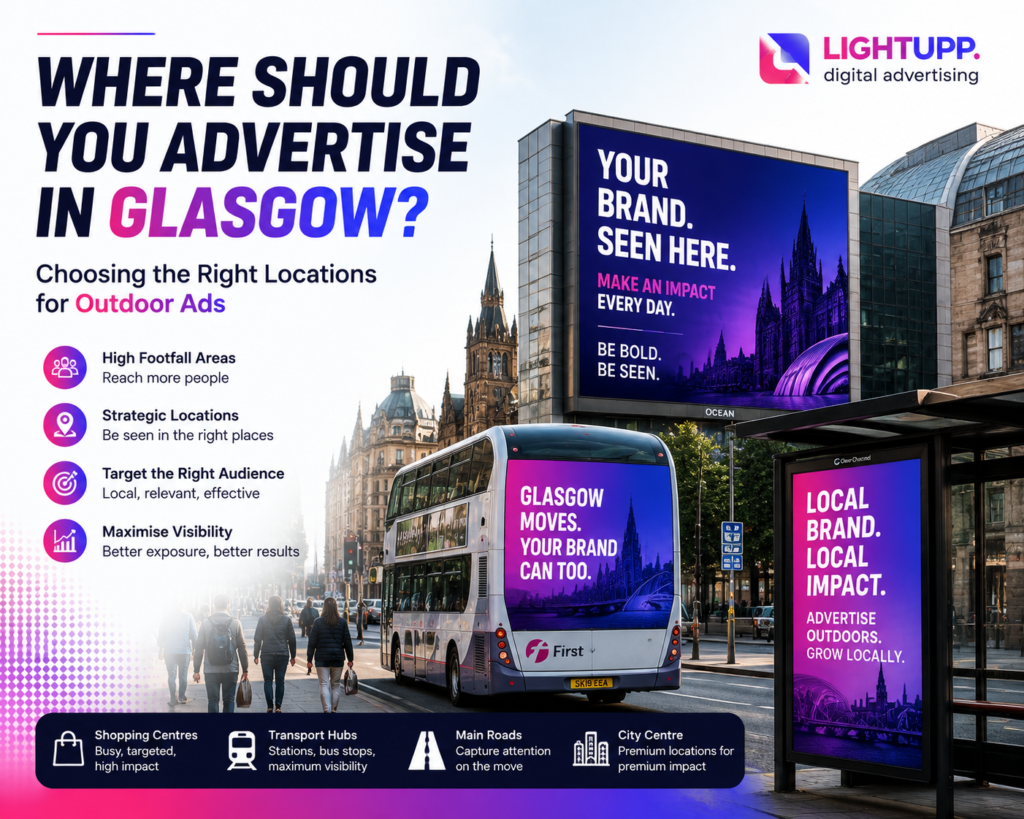
With outdoor advertising, location does more work than the artwork. A brilliant design in the wrong place reaches people who’ll never buy from you; a plain one in the right place gets seen repeatedly by exactly the people you want. Yet location is usually the part businesses think about least, often defaulting to whatever has the biggest footfall number attached. This guide covers how to actually choose where to advertise in Glasgow- what to weigh up, which types of location suit which businesses, and the mistakes that waste otherwise good budget.
Start With Where Your Customers Already Are
The instinct is to chase the busiest spot available. But footfall on its own is a vanity number- what matters is how many of those people could plausibly become customers.
- A city-centre site with enormous footfall is close to worthless to a plumber covering the south side
- A modest display on a local high street may reach far more genuine prospects
- Relevance beats raw numbers almost every time
So the first question isn’t “where do most people walk past?” It’s “where do the people who’d actually use my business spend their time?” Those are frequently different places, and the gap between them is where budget gets wasted.
The Three Types of Location Worth Considering
1. Near your premises
If people need to physically visit you- a shop, a restaurant, a showroom, a salon- displays close to your location do double duty. They build awareness and they act as directional signage, catching people who are already nearby and might reasonably call in.
This is the most straightforward form of outdoor advertising and often the most effective for premises-based businesses. Proximity means the gap between seeing your ad and acting on it is measured in minutes rather than weeks.
2. On the routes your customers travel
Commuter roads, main arterial routes, and busy junctions work because of repetition. Someone driving the same road every morning sees your name dozens of times over a campaign, and that accumulation builds familiarity in a way a single impression never does.
This suits businesses serving a wider area rather than one neighbourhood- trades, services, anyone whose customers travel to them or who travels to customers across the city.
3. Where the right audience gathers
Some locations concentrate a particular type of person: near university campuses, business districts, retail parks, transport hubs, or venues. If your customers cluster somewhere predictable, advertising there reaches a filtered audience rather than a general one.
This is the most targeted approach and works well when you serve a defined group rather than the general public.
What to Weigh Up for Any Site
Once you have candidate locations, these are the practical considerations:
- Who actually passes it- the demographic, not just the volume
- How they pass it- walking allows more detail, driving demands radical simplicity
- Dwell time- a site at a junction or bus stop gets read; one on a fast road gets glanced at
- Repetition- will the same people see it regularly, or is it mostly one-off traffic?
- Visibility- sightlines, obstructions, lighting after dark
- Proximity to your business or service area
- What else is competing for attention at that spot
Dwell time deserves particular thought. At a busy junction or a bus shelter, people are stationary and will read several words. On a fast dual carriageway, you have a name and perhaps three more words. The site dictates the message, not the other way round.
Green Flags vs Red Flags
Signs a location is right- or that it isn’t:
| Green Flag | Red Flag |
| Reaches people who could genuinely buy | High footfall, wrong audience entirely |
| Same people pass it repeatedly | Mostly one-off passing traffic |
| Close to your premises or service area | Miles outside where you operate |
| Clear sightlines and good visibility | Obscured, or unlit after dark |
| Dwell time suits your message length | Complex message on a fast road |
| Chosen for relevance | Chosen because it was available or cheap |
The Mistakes That Waste Budget
- Choosing on footfall alone without asking who those people are
- Picking a prestigious location that doesn’t reach your actual catchment
- Spreading a small budget across several sites instead of concentrating it- repetition matters more than coverage
- Ignoring how people pass the site, and writing a message the format can’t carry
- Taking whatever’s available rather than waiting for the right site
- Running for too short a period for repetition to do its work
That third point is the one that catches most businesses. Given a limited budget, one well-chosen site running for longer will almost always outperform three sites running briefly, because outdoor advertising works through accumulated familiarity rather than raw reach.
Match the Message to the Site
Once you’ve chosen where, the location should shape what you say. A site people walk past slowly can carry a short sentence and a call to action. A roadside display needs your name, one idea, and nothing else. A display near your premises can point people in- “just around the corner” works there and nowhere else.
Businesses that treat artwork as fixed and locations as interchangeable get worse results than those who design for the specific site. If you’re running more than one, it’s worth adapting the message to each rather than reusing identical artwork everywhere.
Why Glasgow Businesses Choose LightUpp
Choosing locations well takes knowing the city rather than reading footfall figures off a rate card- which routes carry which audiences, where dwell time is genuinely useful, and which sites look impressive but won’t reach the people you need. LightUpp has run outdoor advertising across Glasgow for years, and because outdoor sits alongside our social media, paid advertising and branding work, what appears on a display is consistent with everything else your customers see. You can view available locations at lightupp.co.uk/outdoor/locations/.
Frequently Asked Questions
Is a busier location always better for outdoor advertising?
No. Footfall on its own tells you how many people pass, not how many could become customers. A quieter site that reaches your actual catchment will usually outperform a busy one full of people who’d never use your business.
Should I use several locations or one?
With a limited budget, one well-chosen site running longer generally beats several running briefly. Outdoor works through repetition, so the same people seeing your name regularly matters more than reaching a wider spread once.
How do I know if a location reaches my customers?
Think about where your existing customers live, work, and travel. Look at the routes between those places and your business, and consider whether the site sits on one of them. Your own customer base is the best available guide.
Does the type of location change what my advert should say?
Yes, considerably. A site people pass on foot or while stationary can carry more words than one on a fast road, where you have a name and one idea at most. The site should shape the message rather than the message being fixed in advance.
Related Reading
More on making outdoor advertising work:
- Outdoor Advertising in Glasgow: Does It Still Work for Local Businesses?– whether outdoor suits your business in the first place- https://lightupp.co.uk/outdoor-advertising-in-glasgow-does-it-still-work-for-local-businesses/
- Advertising in Glasgow: Which Type of Advertising Works Best for Local Businesses?– comparing outdoor against your other options- https://lightupp.co.uk/advertising-in-glasgow-which-type-of-advertising-works-best-for-local-businesses/
- The Half-Second Test: Why Branding Decides Whether Glasgow Customers Notice You– why your display must match the rest of your brand- https://lightupp.co.uk/the-half-second-test-why-branding-decides-whether-glasgow-customers-notice-you/


