



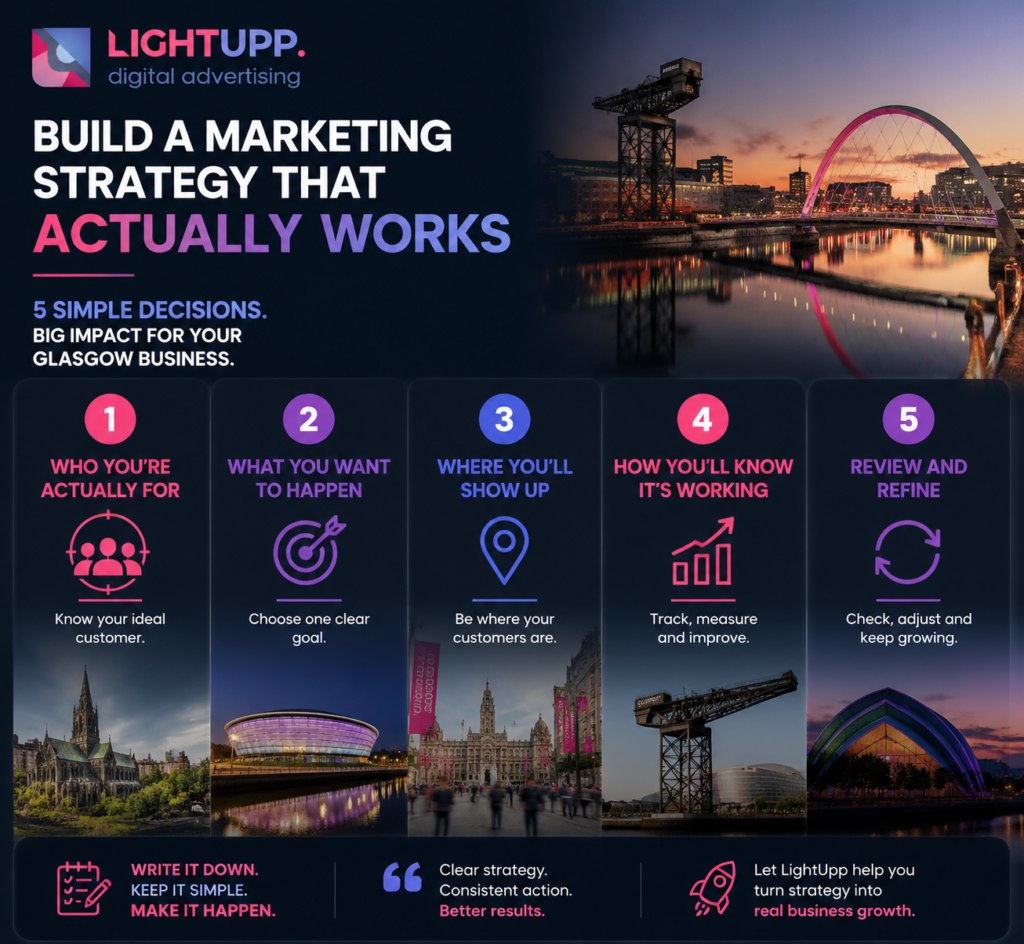
Most small business marketing strategies fail for the same reason: they’re too big to ever get finished. Someone reads that they need a strategy, opens a forty-page template, fills in three sections, and never looks at it again. Meanwhile the marketing carries on being decided week to week based on whatever feels urgent. A useful strategy for a small business isn’t a document – it’s a handful of decisions written down somewhere you’ll actually see them. This guide covers the decisions that matter, in the order worth making them, and what you can safely ignore.
What a Strategy Actually Is
Strip away the jargon and a marketing strategy answers four questions:
- Who are you trying to reach?
- What do you want them to do?
- Where will you reach them?
- How will you know if it’s working?
That’s it. Everything else – personas, positioning statements, channel matrices – is elaboration on those four. If you can answer them clearly and act on the answers consistently, you have a strategy. If you can’t, no amount of documentation will help.
The distinction worth holding onto: strategy is what you’ve decided, tactics are what you do. Posting on Instagram is a tactic. Deciding that Instagram is where your customers are and that your goal is enquiries rather than followers – that’s the strategy that makes the tactic worth doing.
Decision 1: Who You’re Actually For
The instinct is to say “anyone who needs what I sell”, because narrowing feels like turning away business. In practice the opposite happens – marketing aimed at everyone speaks to nobody, while marketing aimed at a specific person is what makes that person feel understood.
Useful ways to get specific
- Look at your best existing customers – not the biggest, the ones you’d want more of
- Note what they have in common: situation, problem, what triggered them to look
- Write down the words they use to describe their problem, not the words you’d use
- Be clear about who you’re not for – it makes everything else sharper
That third point does a surprising amount of work. Businesses routinely describe themselves in industry language while customers search in plain terms, and the gap between the two costs visibility and clarity at once.
Decision 2: What You Want to Happen
“More customers” isn’t a goal you can act on. A goal you can act on names a specific action you want a specific person to take.
- Enquiries through a form or DM
- Phone calls
- Bookings or orders
- Repeat business from existing customers
This matters because different goals need different marketing. Content designed to build awareness looks nothing like content designed to convert someone who’s already deciding. Businesses that skip this decision tend to produce content that does neither particularly well – it fills the feed without moving anyone toward anything.
Pick one primary goal for the next quarter. You can have secondary ones, but one thing should be clearly most important, or every decision becomes a debate.
Decision 3: Where You’ll Actually Show Up
This is where most small businesses overreach. The honest constraint is time – whatever you choose has to be sustainable when you’re busy, because that’s exactly when marketing gets dropped.
Choosing sensibly
- Start from where your customers already are, not where you find it easiest to post
- Pick one or two channels you can genuinely maintain, not five you’ll manage for a month
- Consider intent – search reaches people already looking, social reaches people who aren’t
- Account for your own capacity honestly, including the weeks when work is busy
Two channels done consistently beat five done sporadically, and it isn’t close. An account that goes quiet reads as a business that might not be trading, which does active damage rather than simply achieving nothing.
Decision 4: How You’ll Know It’s Working
You don’t need sophisticated analytics. You need to know, at the end of each month, whether the effort produced anything.
- Where did this month’s enquiries come from? Ask, if you don’t know.
- Did the number go up, down, or stay flat compared to last month?
- What did you spend – in money and in your own hours?
- What’s the one change worth making next month?
Tracking enquiry source is the single most valuable habit here and the one most businesses skip. Without it you’re guessing about which activity deserves more effort, which usually means the loudest channel gets the credit rather than the effective one.
Green Flags vs Red Flags
How to tell whether your strategy is real or theoretical:
| Green Flag | Red Flag |
| Fits on a single page you actually reread | A long document nobody has opened since |
| Names a specific customer you’re for | Aimed at ‘anyone who needs this’ |
| One clear primary goal this quarter | Several competing priorities, none first |
| Channels you can sustain when busy | More channels than time allows |
| You know where enquiries come from | No idea what’s actually producing results |
| Reviewed monthly, adjusted deliberately | Set once, never revisited |
What You Can Safely Skip
Plenty of standard strategy advice is written for businesses with marketing departments. For a small business, most of it is overhead:
- Elaborate customer personas with invented names and stock photos
- Twelve-month content calendars planned in advance – they never survive contact with reality
- Competitor analysis spreadsheets updated monthly
- Positioning statements written in language you’d never say out loud
- Channels you’ve added because you feel you should be there
None of this is wrong in principle. It’s just that the time spent producing it is usually time not spent doing the marketing itself, and for a small business that trade rarely pays.
Putting It on One Page
A workable format, written in plain sentences:
- We’re for: [specific customer and situation]
- We want them to: [specific action]
- We’ll reach them via: [one or two channels]
- We’ll post/do: [what, how often, realistically]
- We’ll know it’s working if: [specific measurable thing]
- We’ll review this on: [date]
Six lines. Print it, pin it somewhere visible, and check it monthly. A strategy you reread is worth more than a better one you don’t.
Why Small Businesses Choose LightUpp
A lot of what makes marketing work is deciding what not to do – and that’s harder from inside the business, where everything feels equally urgent. LightUpp handles social media, paid advertising, branding and video with one team working to a single plan, so effort goes where it’ll count instead of being spread thin. If your strategy is sound and it’s execution that keeps slipping, that’s usually the point where handing it over pays for itself. More on how we work over on our site.
Frequently Asked Questions
How long should a small business marketing strategy be?
One page is enough, and arguably better than more. The value is in having made clear decisions you’ll actually revisit, not in the length of the document – long strategies tend to get written once and never reopened.
How often should I review my strategy?
Monthly for a quick check on what’s working, and properly every quarter. Reviewing more often tends to produce reactive changes before anything has had time to show results.
What if I don’t know who my ideal customer is yet?
Start with your best existing customers and look for what they have in common. If you’re too new to have a pattern, make your best guess, act on it, and refine as real customers arrive – a provisional answer you can test beats waiting for certainty.
Do I need a strategy if I only use one channel?
Yes, and it’s simpler to write. Knowing who you’re for, what you want them to do, and how you’ll measure it matters just as much on one channel – arguably more, since there’s less room to compensate elsewhere.
Related Reading
To put the strategy into practice:
- Instagram vs TikTok vs LinkedIn: Which Platform Is Right for Your Glasgow Business? – choosing which channels to commit to – https://lightupp.co.uk/instagram-vs-tiktok-vs-linkedin-which-platform-is-right-for-your-glasgow-business/
- Advertising in Glasgow: Which Type of Advertising Works Best for Local Businesses? – weighing up paid channels – https://lightupp.co.uk/advertising-in-glasgow-which-type-of-advertising-works-best-for-local-businesses/
- The Half-Second Test: Why Branding Decides Whether Glasgow Customers Notice You – why consistency matters more than volume – https://lightupp.co.uk/the-half-second-test-why-branding-decides-whether-glasgow-customers-notice-you/


