



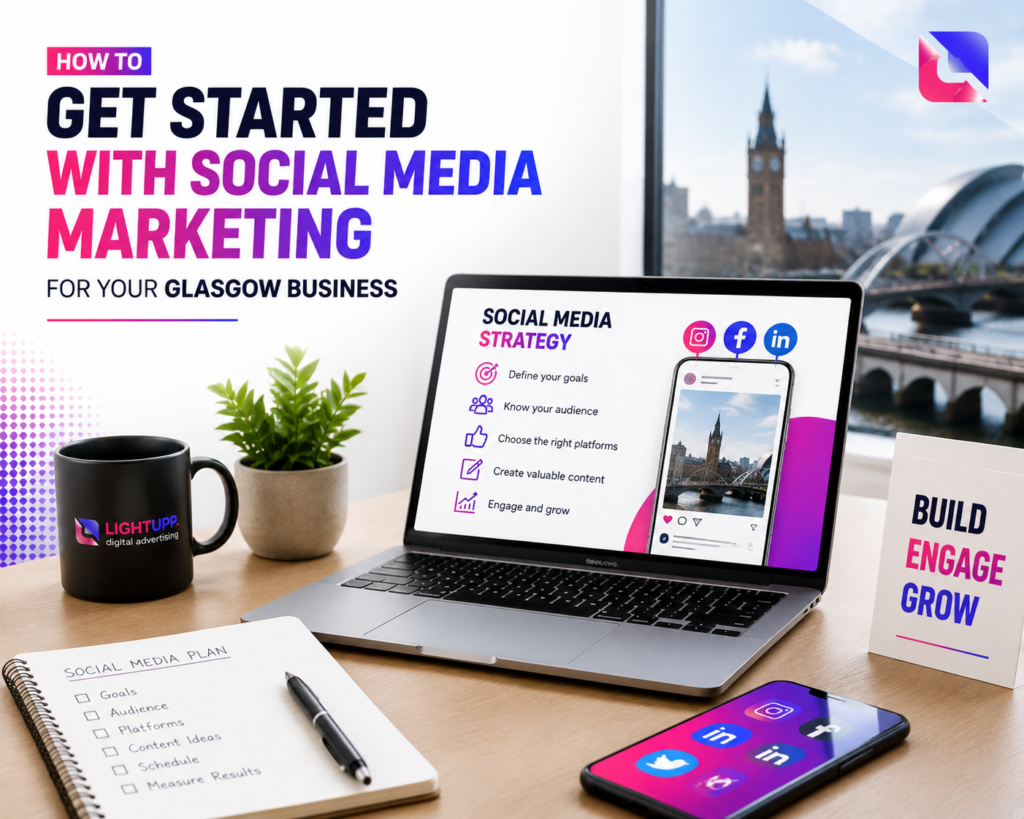
If you’re starting from nothing- or from accounts you set up once and abandoned- the volume of social media advice out there is more paralysing than helpful. Everyone has an opinion on algorithms, posting frequency, and which platform is dying. You don’t need any of that yet. What you need is a small number of decisions made sensibly and then acted on consistently. This guide covers what to do first, in order, and just as importantly what to ignore until you’re properly up and running.
Before Anything Else: Decide What It’s For
The most common reason social media goes nowhere is that nobody decided what it was meant to achieve. Posting because you feel you should produces content aimed at nobody in particular.
Pick one primary purpose to start:
- Being findable and credible when someone checks you out
- Staying visible to past customers so they come back
- Reaching new people who don’t know you exist
- Showing your work so people can judge quality before enquiring
For most Glasgow businesses starting out, the first of those is the realistic goal- people will look you up before buying, and what they find should reassure rather than concern them. That’s a genuinely worthwhile aim, and it’s achievable far faster than building an audience.
Step 1: Pick One Platform, Maybe Two
The instinct is to be everywhere. Resist it. Five neglected accounts look worse than one active account, because people check them and see silence.
A rough guide
- Instagram- if your business is visual: food, retail, trades showing finished work, anything with a look
- Facebook- strong for local reach in Glasgow, events, and an older audience; local groups genuinely generate work
- LinkedIn- if you sell to other businesses rather than the public
- TikTok- high potential reach, but only if you can genuinely commit to regular video
Choose based on where your customers actually are rather than where you personally spend time. If you’re unsure, our comparison of the main platforms goes into the trade-offs properly.
Step 2: Get the Basics Right Before Posting
A surprising amount of value sits in the profile itself, before you’ve posted anything. People land there, form a view in seconds, and act on it.
- A clear profile photo- your logo, correctly sized and not cropped oddly
- A bio that says plainly what you do and where- not a slogan
- Location and contact details filled in properly
- A link to your website
- Consistent naming across platforms so people can find you
This takes an hour and pays off permanently. A profile that clearly states what you do and where you are will convert better than one with a clever tagline and no information.
Step 3: Work Out What to Post
The perennial blocker. The answer is less exotic than people expect- most of it is already happening in your business, you just don’t think of it as content.
- Your actual work- finished jobs, products, before and afters
- The people- you, your team, who customers will deal with
- Behind the scenes- preparation, process, the ordinary day
- Customer reviews and feedback, reshared with thanks
- Useful things you know- the questions customers always ask
- Practical updates- hours, availability, changes, news
A rough balance to aim for: mostly useful or interesting, occasionally promotional. If every post asks for something, people disengage. If most posts give something, the occasional ask is tolerated easily.
Step 4: Decide a Realistic Rhythm
Be honest about what you can sustain when you’re busy, because that’s when it slips. Twice a week maintained for a year beats daily for a fortnight followed by silence- consistency is what signals an active business, and the bar is lower than most people assume.
- Pick a frequency you could manage in your worst week, not your best
- Batch content when you have time rather than scrambling daily
- Take photos as you work- it costs seconds and solves the content problem later
- Use scheduling so a busy week doesn’t create a gap
Green Flags vs Red Flags
Signs you’ve started well- or haven’t:
| Green Flag | Red Flag |
| One or two accounts, kept current | Five accounts, all half-abandoned |
| Profile clearly states what you do and where | Clever bio that explains nothing |
| Posting a rhythm you can sustain | Daily for two weeks, then nothing |
| Mostly useful, occasionally promotional | Every post is a sales pitch |
| Replying to comments and messages | Broadcasting with no engagement |
| Real photos of your actual work | Stock images and generic quotes |
What to Ignore for Now
Things that matter eventually but will only slow you down at the start:
- Follower counts- a small local audience that buys beats a large one that doesn’t
- Algorithm theories- consistency matters more than any trick
- Paid advertising- get the organic basics working first, or ads point at a weak profile
- Detailed analytics- useful later, distracting now
- Being on every new platform that appears
When you are ready to consider paid promotion, the sequencing matters- our guide to organic versus paid social covers when it makes sense to start spending.
Your First Month, Realistically
- Week one: choose your platform and set the profile up properly
- Week two: gather content- photos of work, team, premises
- Week three: start posting at your chosen rhythm
- Week four: reply to everything, and keep going
After that, keep going for three months before judging whether it’s working. Social media rewards persistence far more than cleverness, and almost nothing meaningful shows in the first few weeks.
Why Glasgow Businesses Choose LightUpp
Getting started is manageable; keeping it going while running a business is where most people come unstuck. LightUpp handles social media alongside branding, paid advertising and video with one team, so posting happens on schedule and everything looks like it belongs to the same business. That said, if you have the time and want to run it yourself, the steps above are genuinely all you need to begin- and we’d rather you did that well than paid for something you didn’t need yet. More at lightupp.co.uk.
Frequently Asked Questions
Which social media platform should a small business start with?
Whichever your customers actually use. Instagram suits visual businesses, Facebook still carries strong local reach in Glasgow, and LinkedIn works for business-to-business. Starting with one and doing it properly beats spreading across several.
How often should I post when starting out?
Pick a frequency you could maintain in a busy week rather than an ideal one. Twice a week sustained for months will do more than daily posting that stops after a fortnight, because consistency is what signals an active business.
What should I post if my business isn’t visual?
Your work, your people, and what you know. Behind-the-scenes content, answers to questions customers always ask, and reshared reviews all work regardless of sector. Most businesses have more material than they realise- it just feels ordinary because they live with it.
Do I need to pay for ads to get anywhere?
Not at the start. Get the profile right and post consistently first, because ads pointing at a bare or neglected profile convert poorly. Paid promotion is worth considering once the basics are working.
Related Reading
Once you’re up and running, these go further:
- Instagram vs TikTok vs LinkedIn: Which Platform Is Right for Your Glasgow Business?– choosing where to focus- https://lightupp.co.uk/instagram-vs-tiktok-vs-linkedin-which-platform-is-right-for-your-glasgow-business/
- Organic vs Paid Social: Where Should Glasgow Businesses Invest First?– when to start spending on promotion- https://lightupp.co.uk/organic-vs-paid-social-where-should-glasgow-businesses-invest-first/
- The Half-Second Test: Why Branding Decides Whether Glasgow Customers Notice You– why consistency matters more than polish- https://lightupp.co.uk/the-half-second-test-why-branding-decides-whether-glasgow-customers-notice-you/
Started but can’t keep it going? That’s the part we handle → lightupp.co.uk/social-media/


