



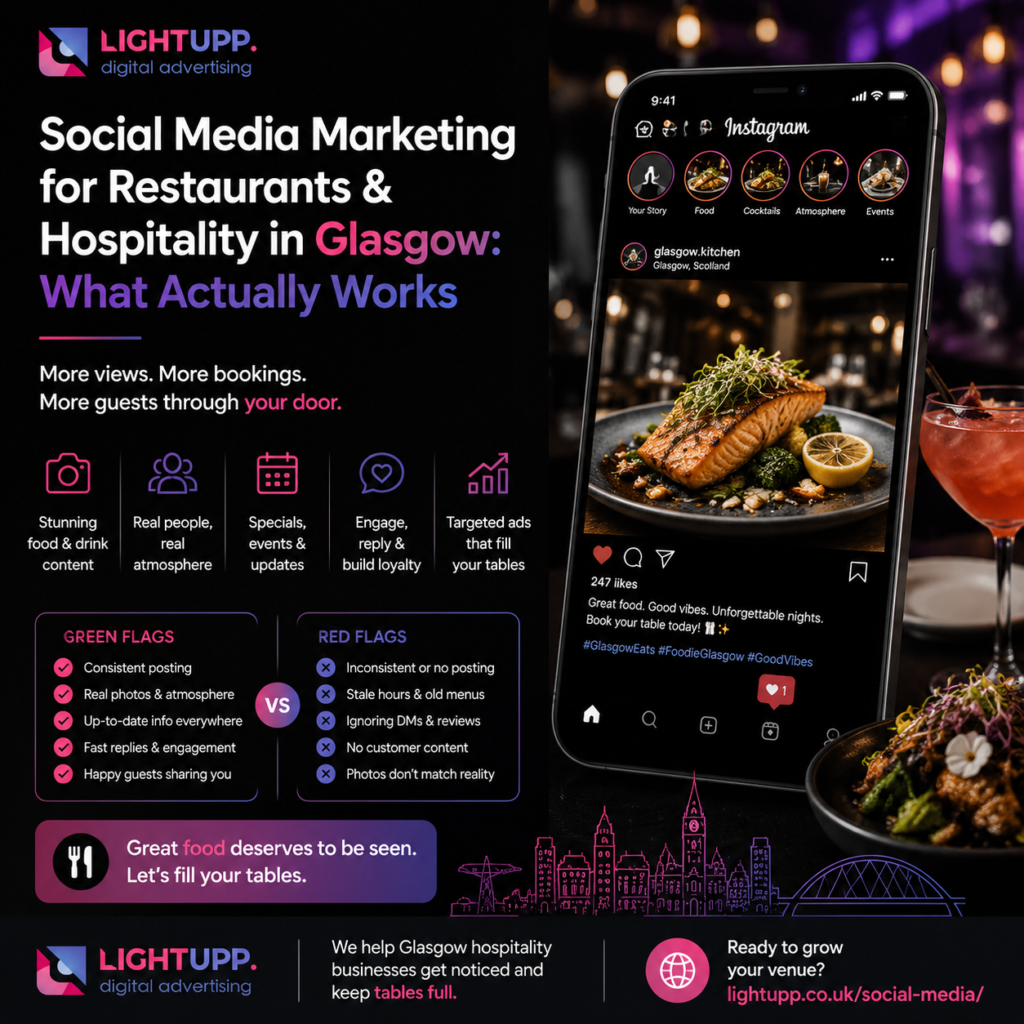
Hospitality is one of the few sectors where social media genuinely decides whether people walk through your door. Someone’s deciding where to eat tonight, they open Instagram or Google, they look at your photos – and that’s the decision made in seconds. Glasgow’s food and drink scene is crowded and competitive, which means an account that looks neglected costs you covers every single night. This guide covers what actually works for restaurants, bars, cafés, and hotels here – which platforms matter, what to post, and the mistakes that quietly empty tables.
Why Hospitality Is Different
Most businesses use social media to build awareness over months. Hospitality operates on a much shorter fuse – someone decides where to eat in the next few hours, and your feed is the deciding factor.
- The decision window is immediate – tonight, this weekend, right now
- It’s overwhelmingly visual – people eat with their eyes before they book
- Competition is dense and local – dozens of alternatives within walking distance
- Reviews and photos carry more weight than anything you say about yourself
- User-generated content is constant – customers post about you whether you’re active or not
That last point matters more than people realise. Your customers are already creating content about your venue. The question is only whether you’re part of that conversation or absent from it.
Which Platforms Actually Matter
You don’t need to be everywhere. For Glasgow hospitality, a few channels do the heavy lifting:
Instagram – the priority
- The default place people check before choosing where to eat
- Photos and Reels of food, drinks, and atmosphere do the selling for you
- Stories work for daily specials, events, and quiet-night pushes
- Tagged customer posts give you free content and social proof
Facebook – still essential locally
- Strong for events, bookings, and reaching an older local audience
- Local groups and shares drive genuine word of mouth
- Still where a lot of people check opening hours and reviews
TikTok – high reward, high effort
- Enormous reach potential for venues with genuine personality
- Rewards authenticity over polish – kitchen clips, staff, atmosphere
- Only worth it if you can post consistently; sporadic posting goes nowhere
If you’re weighing up where to concentrate effort, our platform comparison guide breaks down the trade-offs in more detail.
What to Actually Post
The content that works in hospitality is rarely the content venues think will work. Polished, over-styled shots often perform worse than something real and immediate.
- Food that looks like the food people will actually receive – not unrecognisable styling
- Atmosphere – the room busy, the bar lit, the terrace on a good evening
- People – your chefs, your bar staff, your regulars; venues are about people
- Specials and changes – today’s dish, this week’s menu, a new cocktail
- Behind the scenes – prep, deliveries, the kitchen mid-service
- Customer content – reshare tagged posts, with credit
- Practical information – opening hours over holidays, booking links, events
One firm rule: your photos must match the experience. Nothing damages a venue’s reputation faster than food that looks nothing like the picture that got someone through the door.
Green Flags vs Red Flags
A quick audit of your venue’s social presence:
| Green Flag | Red Flag |
| Photos look like the actual food you serve | Heavily styled shots that set false expectations |
| Posting consistently, including quiet periods | Silence for weeks, then a burst of posts |
| Opening hours and menus current everywhere | Stale hours over holidays, outdated menu |
| Tagged customer posts reshared and credited | Customer content ignored entirely |
| Comments and booking DMs answered fast | Messages unanswered while people book elsewhere |
| Feed matches the real atmosphere of the venue | Feed and venue feel like different businesses |
The Mistakes That Cost Glasgow Venues Bookings
- Only posting when it’s quiet – people notice the desperation, and consistency is what builds the habit of checking you
- Ignoring DMs – a booking enquiry left for a day is a table lost to someone who replied
- Letting hours go stale over holidays – a wasted journey turns a customer into a bad review
- Never resharing customer content – your regulars are making free content and you’re ignoring it
- Boosting posts with no targeting and calling it advertising – that’s not the same as running ads properly
- Treating the feed as separate from the venue – the vibe online should match the vibe in the room
On that second-to-last point: a lot of venues conclude paid social doesn’t work when what they’ve actually done is boost a post without targeting. Our guide to why Facebook and Instagram ads aren’t working covers the difference and the common fixes.
Why Glasgow Hospitality Businesses Choose LightUpp
LightUpp has worked with Glasgow venues and hospitality brands, and the pattern is consistent: the venues that win aren’t the ones with the biggest budget, they’re the ones whose social presence looks as good as their food actually is. We handle the content, the consistency, and the paid promotion together – so your feed reflects the real atmosphere of the room, your specials reach people deciding where to go tonight, and your budget goes toward filling tables rather than chasing followers.
Frequently Asked Questions
How often should a restaurant post on social media?
Consistency matters more than volume. A venue posting a few times a week reliably will outperform one that posts daily for a fortnight then goes silent for a month, because people build the habit of checking accounts that are dependably active.
Do I need a professional photographer for food photos?
Not always. Good natural light and an honest shot of what you actually serve often beats over-styled photography, since the goal is to set accurate expectations. Professional work pays off for menu launches and hero images, but day-to-day content can be shot in-house.
Is Instagram or Facebook better for a Glasgow restaurant?
Instagram usually leads for discovery and visual appeal, while Facebook still holds strong local reach for events, bookings, and an older audience. Most venues benefit from both, with Instagram taking the bulk of the effort.
Should I reply to bad reviews about my venue?
Yes, calmly and factually. Prospective customers judge your response more than the complaint itself – a measured reply often builds more trust than the review cost you.
Related Reading
To sharpen your venue’s social presence, these guides go further:
- Instagram vs TikTok vs LinkedIn: Which Platform Is Right for Your Glasgow Business? – deciding where to focus your effort – https://lightupp.co.uk/instagram-vs-tiktok-vs-linkedin-which-platform-is-right-for-your-glasgow-business/
- Why Your Facebook and Instagram Ads Aren’t Working: 7 Fixes for Glasgow Businesses – why boosting posts isn’t the same as advertising – https://lightupp.co.uk/why-your-facebook-and-instagram-ads-arent-working-7-fixes-for-glasgow-businesses/
- The Half-Second Test: Why Branding Decides Whether Glasgow Customers Notice You – why your feed has seconds to make an impression – https://lightupp.co.uk/the-half-second-test-why-branding-decides-whether-glasgow-customers-notice-you/
Want your venue’s social media working as hard as your kitchen? LightUpp will make it happen → lightupp.co.uk/social-media/


