


It’s one of the most common questions we hear from Glasgow business owners: should I focus on growing my social media organically, or put money behind paid ads? The honest answer is that they do different jobs, and the right split depends on your goals, your timeline, and your budget. Lean too hard on organic and growth can feel painfully slow; jump straight to paid without any foundation and you can burn through budget fast. This guide explains what each approach actually delivers, where each one falls short, and how to think about splitting your effort and spend so they work together rather than competing.
What’s the Actual Difference?
The distinction is simpler than it’s often made to sound:
- Organic social – everything you post for free: photos, videos, stories, and updates that reach your followers and whoever the algorithm chooses to show them.
- Paid social – content you put budget behind so the platform shows it to a specific, targeted audience beyond your existing followers.
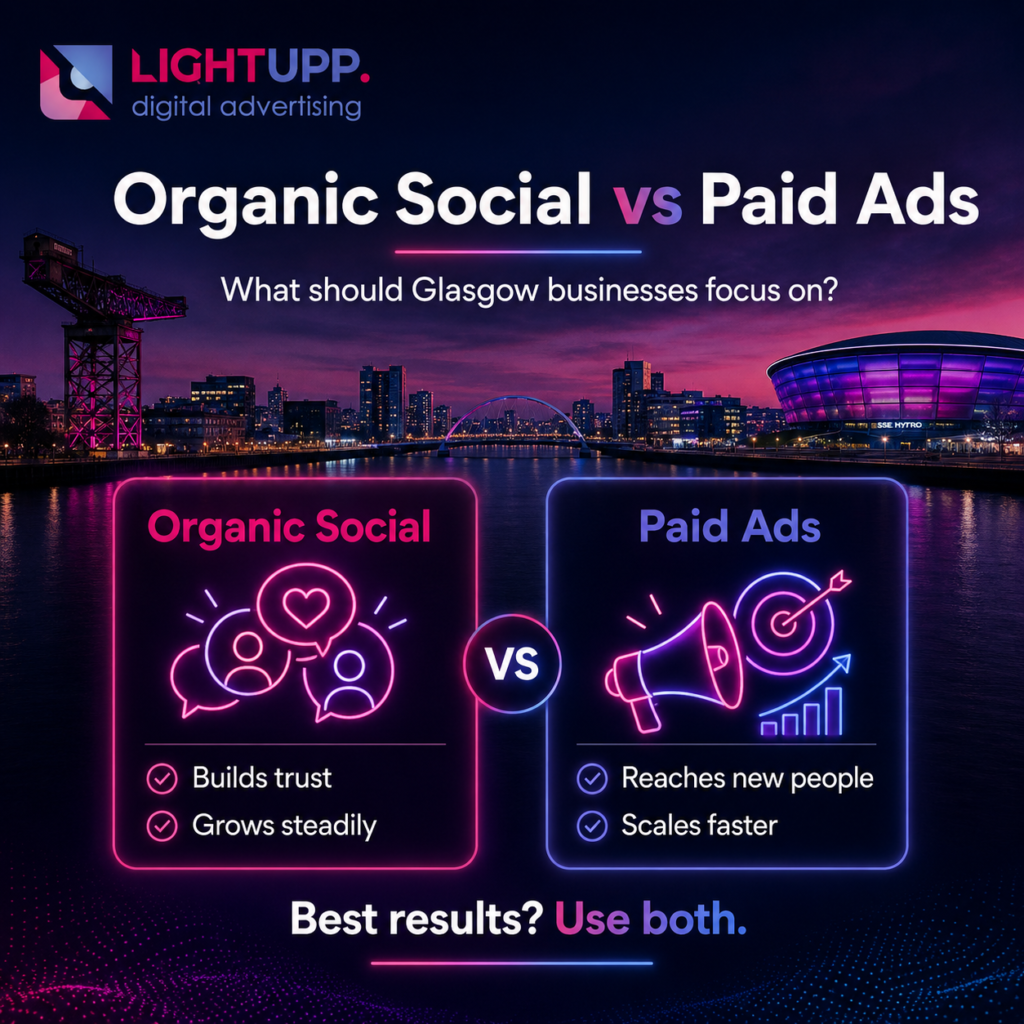
They’re not rivals. Organic builds your brand, credibility, and relationship with the people who already know you. Paid gets you in front of new people quickly and predictably. The strongest results almost always come from using both – which is why treating it as a strict either/or usually leads to the wrong decision.
What Organic Social Does Well
Organic is the foundation – the ongoing presence that makes your business look active, credible, and worth following.
The strengths
- It’s free to post – no media spend required
- Builds genuine relationships and trust with your audience over time
- Showcases your brand’s personality and proof – reviews, work, behind the scenes
- Creates a credible presence people check before they buy
The limitations
- It’s slow – building a meaningful following takes months of consistency
- Reach is limited and declining – platforms increasingly favour paid content
- Mostly reaches people who already follow you, not new prospects
- It’s not really ‘free’ – it costs significant time and consistent effort
A weak or inconsistent organic presence undermines everything else, because it’s the first thing a potential customer checks. If your last nine posts don’t hold up next to a competitor’s, that’s a branding problem worth fixing before you spend on ads – our piece on the half-second test digs into exactly why.
What Paid Social Does Well
Paid social is how you reach beyond your existing followers on a predictable timeline – the growth lever when organic alone isn’t fast enough.
The strengths
- Fast – you can be in front of new, targeted audiences within days
- Precise targeting – by location, age, interests, and behaviour
- Scalable – increase budget on what’s working to grow results
- Measurable – track spend against leads and sales directly
The limitations
- It costs money, and results stop when the spend stops
- It’s easy to waste budget without the right setup and targeting
- Ads pointed at a weak profile or poor landing page convert badly
- It rewards testing and optimisation – ‘set and forget’ underperforms
A crucial point: paid ads amplify whatever you point them at. If the underlying brand, offer, or landing experience is weak, paid spend just makes that weakness more expensive. Plenty of Glasgow businesses conclude ‘ads don’t work’ when the real issue is setup – we covered the most common culprits in our post on why Facebook and Instagram ads aren’t working.
Green Flags vs Red Flags: Getting the Balance Right
Here’s how to tell your organic-and-paid mix is healthy – or that something’s off:
| Green Flag | Red Flag |
| A consistent organic presence backs up your ads | Ads point to a stale, neglected profile |
| Paid budget goes to tested, proven content | Money thrown at untested posts and hoping |
| Clear goal for each – brand vs leads | No idea what either is actually meant to achieve |
| Ads lead to a strong page or offer | Traffic sent to a weak or broken landing page |
| Spend scales with what’s working | Same budget regardless of results |
| Organic and paid reinforce each other | The two run in isolation, pulling different ways |
So Where Should You Invest First?
For most Glasgow businesses, the sensible order is: get organic to a credible baseline first – consistent posting, a profile that looks active and trustworthy, clear proof of what you do – then layer paid on top to accelerate. If you’re established with a solid presence already, you can weight more heavily toward paid to drive growth. The mistake to avoid is pouring budget into ads while your organic presence is bare, because the ads will underperform and you’ll wrongly conclude paid social doesn’t work. Build the foundation, then amplify it.
Why Glasgow Businesses Choose LightUpp
LightUpp runs organic and paid social as one joined-up strategy, not two disconnected services. The same team keeping your profiles active and on-brand is the one running your paid campaigns – so your ads point to a presence that actually backs them up, and your budget goes to content that’s already proven to land. That alignment is exactly what stops paid spend from being wasted on a weak foundation, and it’s why the two together consistently outperform either on its own.
Frequently Asked Questions
Should I grow my following before running ads?
You don’t need a huge following, but you do need a credible, active presence. Ads that point to a bare or neglected profile convert poorly, so getting organic to a solid baseline first makes your paid spend work harder.
Is organic social really free?
There’s no media cost, but it’s far from free in practice – it takes consistent time and effort to post well, engage, and maintain momentum. That time is a real cost worth factoring in when you compare it to paid.
How should I split my budget between organic and paid?
It depends on your stage. Newer businesses usually invest more effort in building an organic foundation first, then add paid to accelerate. Established businesses with a strong presence can weight more toward paid to drive growth.
Why are my paid ads not converting?
Common causes are weak targeting, pointing ads at an unconvincing profile or landing page, or running untested content. Paid amplifies whatever it’s aimed at, so fixing the underlying offer and setup usually matters more than the budget itself.
Related Reading
To get more from both sides of your social strategy, these are worth a read:
- The Half-Second Test: Why Branding Decides Whether Glasgow Customers Notice You – why a strong organic presence starts with consistent branding – https://lightupp.co.uk/the-half-second-test-why-branding-decides-whether-glasgow-customers-notice-you/
- Why Your Facebook and Instagram Ads Aren’t Working: 7 Fixes for Glasgow Businesses – the most common reasons paid social underperforms – https://lightupp.co.uk/why-your-facebook-and-instagram-ads-arent-working-7-fixes-for-glasgow-businesses/
- Instagram vs TikTok vs LinkedIn: Which Platform Is Right for Your Glasgow Business? – choosing where to focus your organic and paid effort – https://lightupp.co.uk/instagram-vs-tiktok-vs-linkedin-which-platform-is-right-for-your-glasgow-business/
Want a social strategy where organic and paid actually work together? LightUpp will build you one → lightupp.co.uk/social-media/


