


If you’ve got a budget for paid advertising and you’re staring at Facebook Ads and Google Ads wondering which to start with, you’re asking exactly the right question. They work in fundamentally different ways, suit different goals, and there’s no point running both badly when you could run one well. The right starting point comes down to a simple distinction: whether your customers are actively searching for what you offer, or whether you need to put your business in front of them before they’ve thought to look. This guide explains how each platform works, what they cost, and how to decide which one your Glasgow business should try first.
The Core Difference: Demand Capture vs Demand Creation
Almost everything about choosing between the two comes back to one idea:
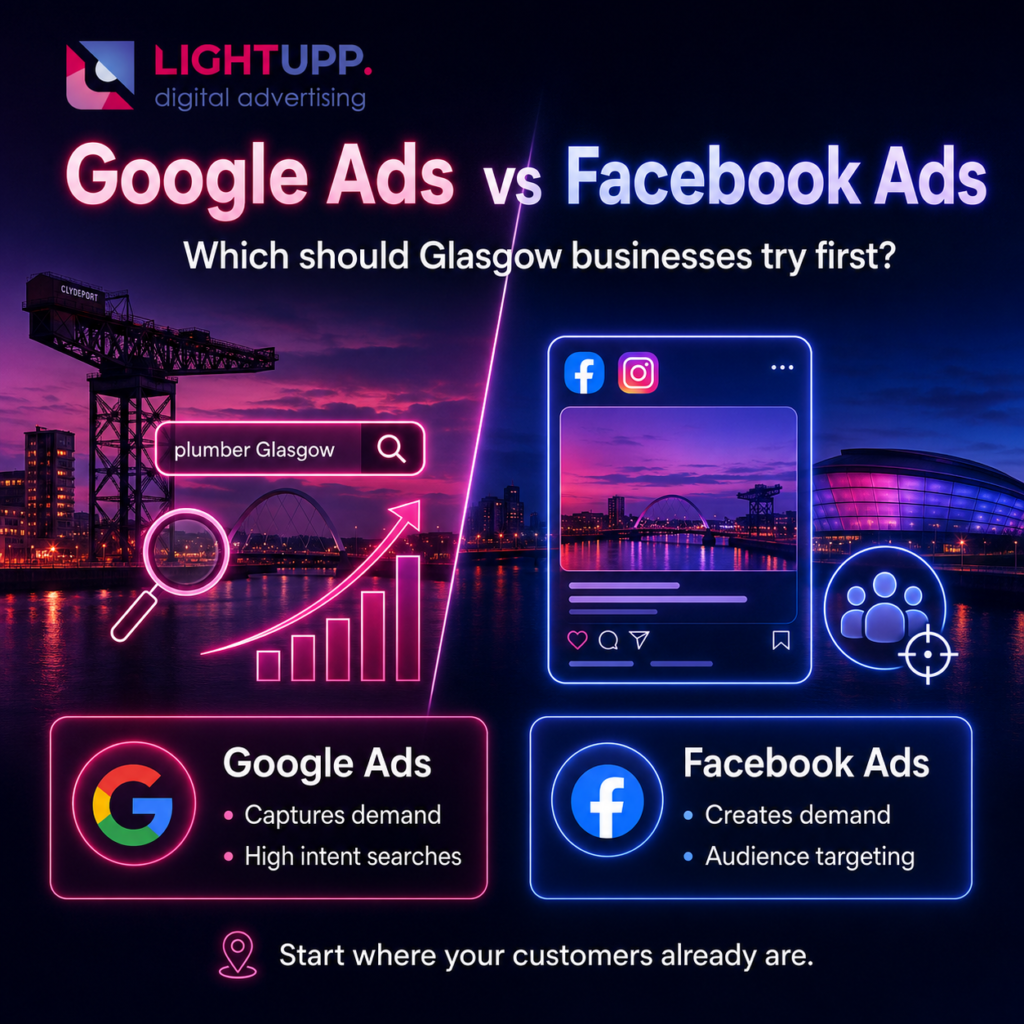
- Google Ads captures existing demand. Someone types ’emergency plumber Glasgow’ into Google, and your ad appears. They already want what you offer – you’re competing to be the one they pick.
- Facebook Ads (and Instagram) create demand. People aren’t searching; they’re scrolling. Your ad interrupts their feed to introduce your business to people who match your target audience but weren’t actively looking.
Neither is better in the abstract – they suit different situations. The question is whether people are already searching for what you sell, or whether you need to spark interest before they’d think to look for you.
When Google Ads Is the Better Starting Point
Google Ads shines when there’s active, existing search demand for what you offer – people already looking, ready to act.
Google Ads tends to win when
- People actively search for your service – plumbers, locksmiths, solicitors, dentists
- You solve an urgent or immediate need (’emergency’, ‘near me’, ‘today’)
- Purchase intent is high – they want it now, not someday
- You can answer a clear, specific search query directly
Things to keep in mind
- Competitive keywords can carry a high cost per click
- You’re billed per click whether or not it converts, so setup matters
- It captures demand that exists – it won’t create awareness where there’s none
If your customers reach for Google the moment they need you, that’s usually where your first ad budget should go – you’re meeting people at the exact moment they’re ready to buy.
When Facebook Ads Is the Better Starting Point
Facebook and Instagram Ads come into their own when people aren’t searching for you yet – when you need to build awareness and interest rather than capture it.
Facebook Ads tends to win when
- People wouldn’t necessarily think to search for what you offer
- Your product is visual – food, fashion, interiors, events, beauty
- You’re building brand awareness or launching something new
- You want precise audience targeting by location, interests, and behaviour
Things to keep in mind
- You’re interrupting, not answering intent, so the creative has to earn attention
- It often takes more testing to find what resonates
- A weak profile or offer undermines results – the ad is only half the job
Many businesses decide ‘Facebook ads don’t work’ when the real problem is setup, targeting, or creative rather than the platform. We broke down the most common reasons in our guide to why Facebook and Instagram ads aren’t working – worth reading before you write the channel off.
Green Flags vs Red Flags: Signs You’re on the Right Platform
Whichever you start with, here’s how to tell it’s the right fit – or that you’ve backed the wrong horse:
| Green Flag | Red Flag |
| Google: strong search demand exists for your service | Google: nobody’s searching, so ads barely show |
| Facebook: your product is visual and scroll-stopping | Facebook: dry offer that needs active intent to sell |
| Cost per lead is sustainable for your margins | Paying more per lead than a customer is worth |
| Ads point to a strong page or profile | Traffic lands on a weak or broken page |
| Clear tracking from click to enquiry | No idea which platform drives results |
| Budget matched to how people find you | Spreading spend thin across both, badly |
So Which Should You Try First?
The simplest way to decide: if people actively search for what you offer, start with Google Ads and capture that demand. If they wouldn’t think to search – or your product sells on how it looks – start with Facebook and Instagram to build awareness. Get one working properly before adding the other. Running both at once on a small budget usually means doing neither well, whereas nailing the right single channel first gives you results and data to build on. Over time, the strongest paid strategies use both together – Google to capture intent, Facebook to create it – but that’s where you grow to, not where you start.
Why Glasgow Businesses Choose LightUpp
LightUpp doesn’t push every client toward the same platform – we start by working out where your customers actually are and how they find businesses like yours, then put your budget where it’ll work hardest. Whether that’s Google, Facebook and Instagram, or a considered mix, campaigns are built around your goals, pointed at a strong landing experience, and optimised on real performance rather than left to run on autopilot. That’s the difference between paid ads that quietly drain budget and paid ads that bring in customers.
Frequently Asked Questions
Is Google Ads or Facebook Ads cheaper?
It depends entirely on your industry and goals rather than one being universally cheaper. Google’s cost per click can be high in competitive sectors but the intent is stronger; Facebook’s clicks are often cheaper but need more nurturing to convert. What matters is cost per actual result, not cost per click.
Can I run Google Ads and Facebook Ads at the same time?
You can, and mature campaigns often do. But if your budget is limited, it’s usually better to get one platform working well first, then expand. Splitting a small budget across both tends to mean neither gets enough to perform.
Which platform is best for a local service business?
For services people search for in a hurry – plumbers, locksmiths, emergency trades – Google Ads is often the stronger first move because it captures active intent. For visual or discovery-led businesses, Facebook and Instagram usually work better to start.
Why did my ads fail last time I tried?
Most often it’s not the platform but the setup – weak targeting, untested creative, or sending clicks to a page that doesn’t convert. Both platforms reward proper setup and ongoing optimisation, and struggle when treated as set-and-forget.
Related Reading
To get the most from your paid advertising, these guides go further:
- Why Your Facebook and Instagram Ads Aren’t Working: 7 Fixes for Glasgow Businesses – the most common setup mistakes that kill paid results – https://lightupp.co.uk/why-your-facebook-and-instagram-ads-arent-working-7-fixes-for-glasgow-businesses/
- The Best Paid Advertising Agencies in Scotland: What to Look for and Who to Trust – what to look for if you’d rather have experts run it – https://lightupp.co.uk/the-best-paid-advertising-agencies-in-scotland-what-to-look-for-and-who-to-trust/
- Advertising in Glasgow: Which Type of Advertising Works Best for Local Businesses? – the wider picture on advertising options for local businesses – https://lightupp.co.uk/advertising-in-glasgow-which-type-of-advertising-works-best-for-local-businesses/
Not sure which platform fits your business? LightUpp will point your budget where it’ll actually work → lightupp.co.uk/online-ads/


