



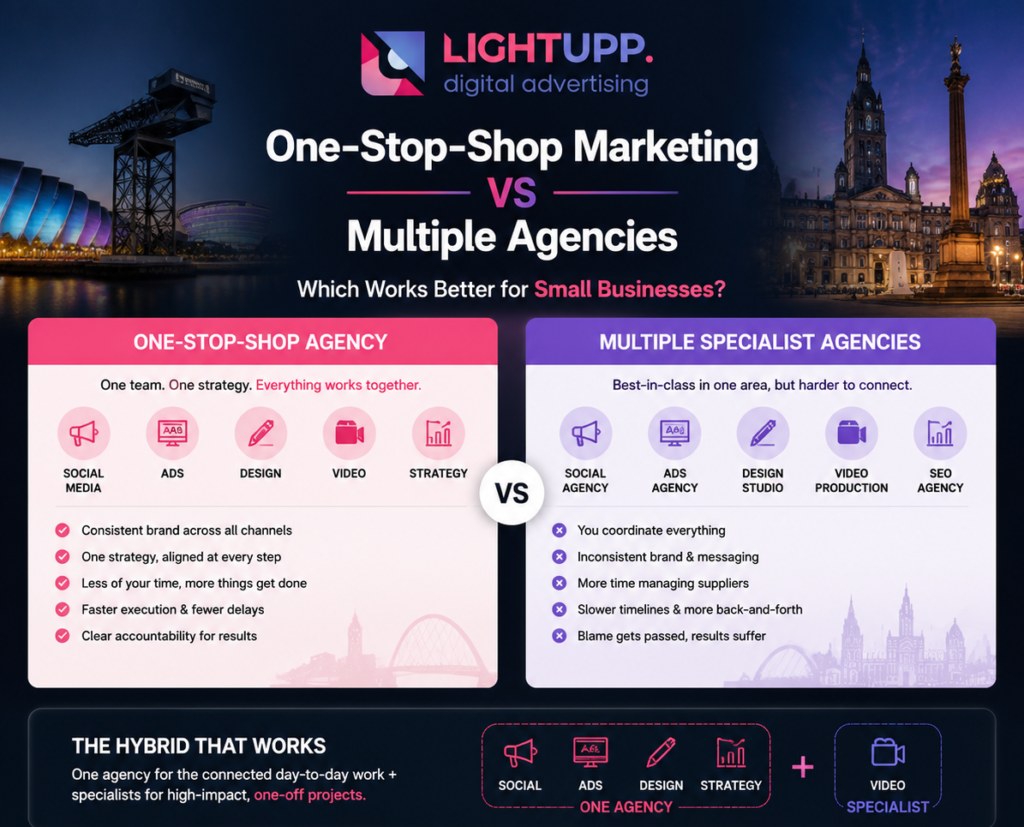
At some point most growing businesses face this question. You need social media, maybe ads, probably some design work, possibly video. Do you find one agency that does all of it, or hire the best specialist for each? Both approaches genuinely work, and both fail in predictable ways. Since we’re a full-service agency, we have an obvious bias here – so this piece is written to be useful rather than persuasive, including the situations where using several specialists is clearly the better call.
The Real Difference
It isn’t about capability. Good specialists and good full-service agencies both do good work. The difference is where the coordination happens.
- With multiple agencies, you are the coordinator. You hold the strategy, brief each supplier, and make sure the pieces fit together.
- With one agency, they coordinate internally. You brief once and they resolve the connections between disciplines themselves.
That’s the whole trade-off. Everything else follows from it – cost, quality, speed, and how much of your own time gets consumed.
Where Multiple Specialists Win
Let’s take this side seriously, because for some businesses it’s clearly correct.
Depth in a specific discipline
A specialist video production company will almost always produce better video than a generalist agency’s video output. Same for a dedicated SEO consultant, or a designer who does nothing but brand identity. If one discipline is genuinely critical to your business, the specialist edge is real.
Flexibility
You can replace one supplier without disrupting everything else. If the ads aren’t working, you change the ads agency and your social continues untouched. With a single agency, changing means changing everything at once.
No compromise on the weak spot
Most full-service agencies are stronger in some areas than others. Using specialists means you’re never accepting a weaker service just because it came bundled with a strong one.
Where it falls down
- You become the project manager, and that’s real ongoing work
- Suppliers rarely talk to each other, so consistency drifts
- Nobody owns the overall strategy – each does their part well in isolation
- Multiple relationships to manage, multiple invoices, multiple briefings
- Blame gets diffuse when results are poor – everyone points elsewhere
That coordination load is the thing businesses consistently underestimate. It doesn’t appear on any invoice, but it’s hours of your week, and it’s the first thing to slip when you get busy.
Where One Agency Wins
Consistency across everything
Your ads look like your social, which looks like your website, which looks like your video. Not because anyone worked hard at coordination, but because the same team made all of it against the same brand guidelines. This is the clearest practical benefit and the hardest to replicate across suppliers.
One strategy, not several
When one team handles social, ads, and brand, the strategy behind each is the same strategy. Specialists optimise their own piece – which is their job – but nobody’s optimising the whole unless you are.
Less of your time
One relationship, one brief, one point of contact, one report. For a small business owner already stretched, this is often the deciding factor rather than a nice-to-have.
Things happen faster
A campaign needing ad creative, social assets, and a landing page moves quicker when it’s one team than when it’s three suppliers with three schedules and three approval cycles.
Where it falls down
- Unlikely to be best-in-class at every discipline
- Changing agency means changing everything at once
- Quality can vary between their strong and weak services
- Easier to become complacent when there’s no direct comparison
Green Flags vs Red Flags
Whichever route you take, these signal whether it’s working:
| Green Flag | Red Flag |
| Everything looks like the same business | Each channel feels like a different company |
| Someone owns the overall strategy | Each supplier optimises only their piece |
| Coordination costs you little time | You spend hours a week managing suppliers |
| Clear accountability for results | Everyone blames another supplier |
| Quality is consistent across services | One strong service, several weak ones |
| You can change course without chaos | Any change means disrupting everything |
The Hybrid Most Businesses Actually End Up With
In practice, the clean either/or is rarer than it sounds. A common and sensible arrangement is one agency handling the connected day-to-day work – social, ads, design, the things that need to look and sound alike – plus a specialist brought in for occasional work that genuinely demands depth, like a major video production or a full rebrand.
That keeps coordination low for the recurring work while allowing specialist quality where it matters most. If you go this route, be explicit about who owns the overall strategy, or you inherit the coordination problem anyway.
How to Decide
A few questions that usually settle it:
- How much time can you genuinely give to coordinating suppliers each week?
- Is one discipline so central to your business that specialist depth is non-negotiable?
- Do your channels currently look and sound like the same business?
- When results are poor, is it clear who’s accountable?
- Would you rather have one very strong service or several consistently good ones?
Broadly: if your marketing needs are connected and your time is short, one agency usually serves you better. If one discipline dominates and you have capacity to coordinate, specialists give you more depth.
Why Small Businesses Choose LightUpp
We’re the one-stop-shop option, so take this in that context: it suits businesses whose needs are connected and whose owners don’t have hours a week to spend briefing three suppliers. Social media, paid advertising, branding and video sit with one team on one strategy, which is why the output looks consistent without anyone having to enforce it.
Frequently Asked Questions
Is a full-service agency more expensive than using specialists?
Not necessarily, and the comparison is harder than it looks. Several specialists each charge their own minimum, and the coordination time you spend has real value that never appears on an invoice. Compare total cost including your own hours rather than fee against fee.
Can I use one agency for most things and a specialist for one?
Yes, and it’s a common arrangement. Keep the connected recurring work with one team and bring in specialists for occasional depth. The important thing is being clear about who owns the overall strategy.
What’s the biggest risk with using multiple agencies?
Drift. Each supplier does good work in isolation while nobody watches the whole, so over months your channels stop looking and sounding like the same business. It happens gradually enough that it’s easy to miss until it’s pronounced.
How do I know if my current setup is working?
Look at your channels side by side as a customer would. If they feel like the same business, your setup is working. If they feel like several different companies, coordination is failing regardless of how good each individual piece is.
Related Reading
More on choosing how to resource your marketing:
- The Best Marketing Companies in Glasgow: What to Look for and Who to Trust – how to assess any agency you’re considering – https://lightupp.co.uk/the-best-marketing-companies-in-glasgow-what-to-look-for-and-who-to-trust/
- The Best Branding & Design Studios in Glasgow: What to Look for and Who to Trust – what specialist depth looks like in branding – https://lightupp.co.uk/the-best-branding-design-studios-in-glasgow-what-to-look-for-and-who-to-trust/
- The Best Paid Advertising Agencies in Scotland: What to Look for and Who to Trust – what specialist depth looks like in paid media – https://lightupp.co.uk/the-best-paid-advertising-agencies-in-scotland-what-to-look-for-and-who-to-trust/
Wondering which setup suits your business? We’ll give you a straight answer, even if it’s not us → lightupp.co.uk


