



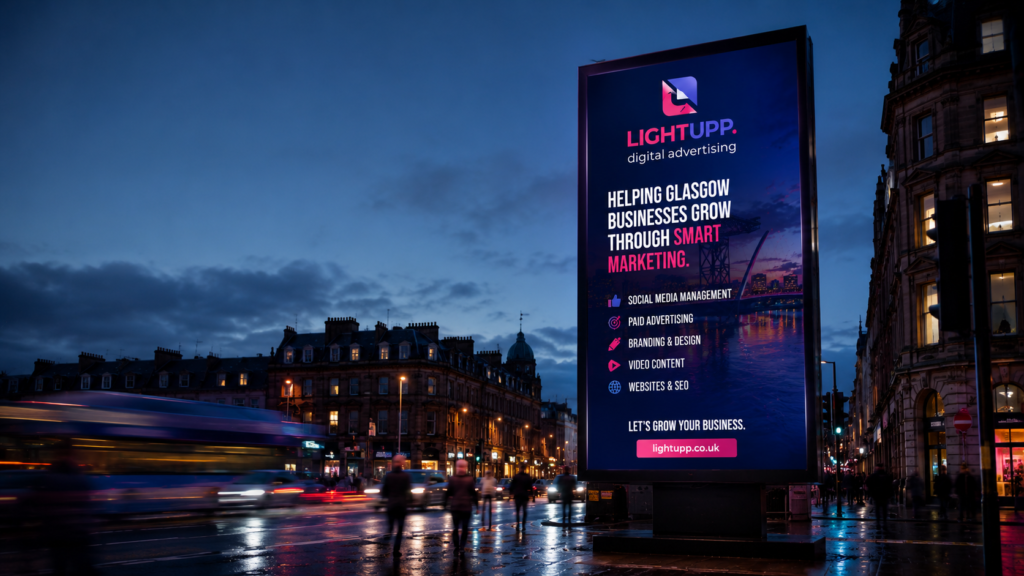
It’s a fair question. In a world where every other marketing channel promises precise targeting and detailed reporting, spending money on something you can’t click, track, or A/B test feels almost old-fashioned. And yet outdoor advertising has not only survived the digital shift, it’s grown – which suggests it’s doing something the trackable channels can’t. This is an honest look at what outdoor advertising genuinely does well, where it genuinely falls short, and which Glasgow businesses it actually suits. Including, plainly, the ones it doesn’t.
What Outdoor Advertising Actually Covers
The term covers more than billboards, and the options differ a lot in cost, reach, and how they’re used:
- Digital screens – rotating displays in high-footfall locations, changeable at short notice
- Billboards and large-format posters – the classic roadside format
- Transport advertising – buses, bus shelters, and station sites
- Street-level formats – smaller displays in shopping areas and town centres
- Retail and venue screens – displays inside places people already spend time
Each suits different goals. A digital screen near a retail park works differently from a poster on a commuter route, and neither is automatically the right choice.
What Outdoor Genuinely Does Well
It can’t be skipped, blocked, or scrolled past
This is the fundamental advantage, and it’s grown more valuable as digital advertising has become easier to avoid. People install ad blockers, skip pre-rolls, and scroll past sponsored posts without registering them. A large display on a route someone travels daily doesn’t offer that option. Attention isn’t guaranteed, but avoidance isn’t either.
Repetition builds familiarity
Someone passing the same display on their commute sees it repeatedly over weeks. That repetition builds a sense of familiarity, and familiarity translates into trust in a way a single impression never does. When they eventually need what you offer, you’re the name that already feels known – which is a real advantage over a competitor they’ve never heard of.
It signals substance
There’s a perception effect that’s hard to replicate digitally. A business visible on a large format reads as established and serious – anyone can run a social ad, but outdoor presence suggests a business of some standing. For smaller businesses competing against bigger names, that signal can be worth more than the raw impressions.
It reaches people you can’t target online
Not everyone is reachable through social platforms, and some audiences are expensive to reach digitally. Outdoor catches people going about their day regardless of their online habits, which makes it genuinely complementary to digital rather than a substitute for it.
Geographic precision
For a local business, being visible in the specific areas you serve is exactly the targeting that matters. A display near your premises or on the routes your customers travel puts you in front of the right people by geography alone.
Where Outdoor Falls Short (The Honest Part)
Any agency telling you outdoor is right for everyone is selling rather than advising. The limitations are real:
You can’t track it the way you track digital
This is the big one, and there’s no getting around it. You won’t get a cost-per-click or a clean attribution report. You can measure proxies – enquiry volume, brand searches, footfall, asking customers how they heard of you – but if you need precise ROI figures on every pound, outdoor will frustrate you.
It’s not built for immediate response
Someone driving past a display isn’t going to stop and buy. Outdoor builds awareness and familiarity that pays off later; it rarely produces the same-day enquiries that search advertising can. If you need leads this week, it’s the wrong tool.
It rewards commitment, not experiments
The repetition effect is where the value sits, which means short bursts underperform. A display up for a fortnight rarely achieves much. This isn’t a channel to dabble in – it works when you commit to a period long enough for familiarity to build.
The message has to be extremely simple
People see outdoor advertising in passing – walking, driving, glancing up from a phone. Anything complicated is lost entirely. If your offer genuinely needs explaining, outdoor is a poor fit for the explanation, though it can still work for the name recognition.
Green Flags vs Red Flags
Signs outdoor advertising suits your business – or doesn’t:
| Green Flag | Red Flag |
| You serve a defined local area | Your customers are scattered nationally |
| Building recognition is the goal | You need enquiries this week |
| Your offer is simple to state | Your service needs explaining to make sense |
| You can commit to a decent run | You want to test it for two weeks |
| You’re comfortable with indirect measurement | You need precise per-pound attribution |
| It complements your digital activity | It’s your only marketing channel |
What Makes Outdoor Advertising Work
When businesses conclude outdoor didn’t work for them, the cause is usually one of these rather than the channel itself:
- One idea only – a headline, a name, a clear offer; anything more is lost
- Legible from a distance and at speed – big type, high contrast, no clutter
- Location chosen around your actual customers, not just footfall numbers
- Long enough to build familiarity rather than a brief flash
- Consistent with your brand elsewhere – same look, same name, same colours
- Paired with digital, so people who notice you can easily find you afterwards
That final point matters more than most businesses realise. Outdoor creates recognition; your digital presence converts it. Someone who sees your display and later searches your name needs to find an active, credible business – which is why outdoor works best alongside a maintained profile rather than in isolation.
Who It Suits – and Who It Doesn’t
Broadly, outdoor advertising suits businesses serving a defined local area, with a simple proposition, who want to build recognition over months rather than chase immediate leads: local services, hospitality venues, retailers, trades, and businesses with premises worth driving people toward.
It’s a weaker fit for businesses with no geographic focus, complex propositions that need explaining, very tight budgets that can’t sustain a proper run, or anyone who needs to demonstrate precise return on every pound. If that’s you, your budget will work harder in trackable digital channels – and we’d say so.
Why Glasgow Businesses Choose LightUpp
Outdoor advertising is one of the services we’ve run longest, and it works best as part of something joined-up rather than on its own. Because the same team handles your outdoor ads, social media, paid advertising and branding, the name someone sees on a display looks and sounds like the business they find when they search for you afterwards. That connection between recognition and conversion is where outdoor earns its keep. If it isn’t the right fit for your business, we’ll tell you that too. More on how we work at lightupp.co.uk.
Frequently Asked Questions
Does outdoor advertising still work in a digital world?
Yes, though for different reasons than digital does. Its advantage is that it can’t be skipped, blocked, or scrolled past, and repeated exposure builds familiarity over time. It’s an awareness channel rather than a direct-response one, which is why it works best alongside digital rather than instead of it.
How do I measure outdoor advertising results?
Not with the precision of digital, honestly. You can track proxies – changes in enquiry volume, searches for your brand name, footfall, and simply asking customers how they heard of you – but you won’t get clean per-click attribution. If exact ROI figures are essential to you, that’s a genuine reason to weight your budget elsewhere.
How long should an outdoor campaign run?
Long enough for repetition to build familiarity, which means months rather than weeks. Short bursts tend to underperform because the effect depends on people seeing your name repeatedly as they go about their routine.
Is outdoor advertising only for big brands?
No – and the perception that it signals an established business is precisely why it can benefit smaller ones. What matters more than size is whether you serve a defined local area with a simple message, which describes a lot of local businesses.
Related Reading
To see how outdoor fits with everything else:
- Advertising in Glasgow: Which Type of Advertising Works Best for Local Businesses? – comparing outdoor against your other channel options – https://lightupp.co.uk/advertising-in-glasgow-which-type-of-advertising-works-best-for-local-businesses/
- The Half-Second Test: Why Branding Decides Whether Glasgow Customers Notice You – why consistency between your display and your digital presence matters – https://lightupp.co.uk/the-half-second-test-why-branding-decides-whether-glasgow-customers-notice-you/
- Google Business Profile for Glasgow Businesses: Why It Matters and How to Get It Right – making sure people who notice you can find you afterwards – https://lightupp.co.uk/google-business-profile-for-glasgow-businesses-why-it-matters-and-how-to-get-it-right/
Wondering whether outdoor advertising suits your business? We’ll give you a straight answer → lightupp.co.uk/outdoor/


