



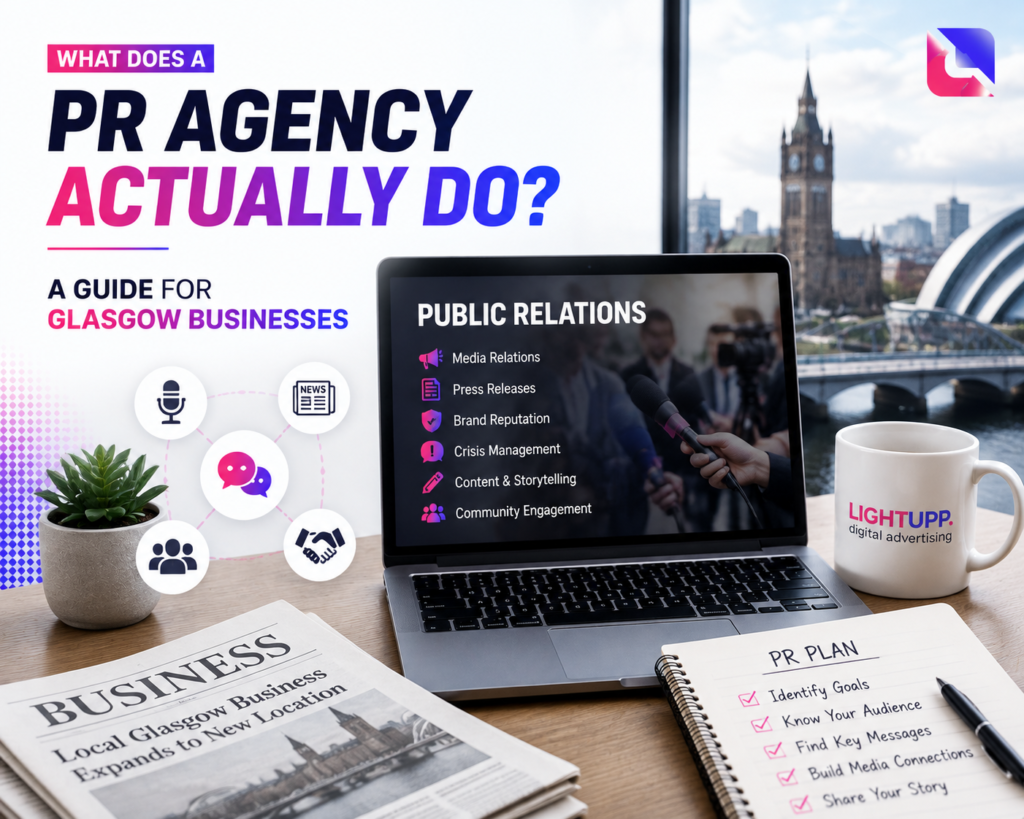
PR is one of the least understood services a business can buy. Everyone has a vague sense it involves getting in the papers, but ask what a PR agency actually does on a Tuesday morning and most people couldn’t say- which makes it hard to judge whether you need one, what you should expect, or whether you’re getting value. This guide explains the work in plain terms: what PR agencies actually do, what the month-to-month reality looks like, and how to tell whether it’s a fit for your business.
The Short Version
A PR agency’s job is to get other people talking about your business favourably- and to manage how you’re perceived when things go wrong. The distinction from advertising is that you’re not buying the space. A journalist, editor, or publication decides whether your story is worth running, which is exactly why the resulting coverage carries weight an advert doesn’t.
That means much of the work is persuasion rather than production: finding an angle worth writing about, getting it in front of the right person, and making it easy for them to say yes.
The Actual Work, Broken Down
Finding the story
This is the part clients rarely see and it’s the foundation of everything else. A good PR agency spends real time working out what about your business is genuinely interesting to someone outside it- a launch, an expansion, a milestone, a local angle, an unusual approach, a person with a story.
Most businesses think they have nothing newsworthy. Usually they have something, but it’s buried in things they consider ordinary because they live with them daily.
Building and using media relationships
PR agencies maintain relationships with journalists, editors, and publications. That matters because a pitch from someone a journalist knows and trusts gets read, while one from a stranger frequently doesn’t. Much of what you’re paying for is access built over years.
Writing and pitching
Press releases, story pitches, comment and opinion pieces, responses to journalist requests. The writing has to suit the publication’s style and needs rather than reading like marketing material- journalists can spot a thinly disguised advert instantly and bin it.
Securing and managing coverage
Following up pitches, handling interview requests, preparing you for them, and making sure the details are right. There’s a lot of chasing involved, and persistence is often what separates coverage from silence.
Awards, events and community work
Entering industry awards, arranging sponsorships, organising or securing places at events, and connecting your business to community activity. All of it creates reasons for people to encounter your name in a positive context.
Reputation management
When something goes wrong- a complaint that escalates, a bad review that spreads, an issue that attracts attention- PR is the discipline for responding well. This is the part nobody thinks about until they need it urgently.
What a Month Actually Looks Like
Behind the service names, a typical month is more mundane than the word ‘PR’ suggests:
- Reviewing what’s happening in your business that might be newsworthy
- Monitoring journalist requests and relevant news your business could comment on
- Writing and sending pitches, then chasing them
- Arranging interviews or supplying quotes and information
- Tracking coverage and where your name is being mentioned
- Reporting back on what ran and what’s in progress
A reasonable question for any agency: what does a typical month look like for a business like mine, and how many pitches translate into coverage? Vague answers there tell you a lot.
Green Flags vs Red Flags
What separates a PR agency worth paying from one that isn’t:
| Green Flag | Red Flag |
| Asks what’s genuinely interesting about you | Promises coverage before knowing anything |
| Honest that some pitches won’t land | Guarantees placements in named publications |
| Reports on coverage secured and attempted | Reports only vague ‘activity’ |
| Knows the publications your market reads | Pitches everywhere indiscriminately |
| Tells you when you have no real story | Manufactures news nobody will run |
| Prepares you properly for interviews | Hands you to a journalist unbriefed |
What PR Won’t Do
Worth being clear, because mismatched expectations sour more PR relationships than poor work does:
- Guarantee coverage- nobody controls whether a journalist runs a story
- Produce results on a fixed timeline, since news moves unpredictably
- Deliver clean attribution linking coverage directly to sales
- Make an uninteresting business interesting without something real to work with
- Replace advertising when you need enquiries by a specific date
Any agency guaranteeing placements in named publications is either overselling or has an arrangement that isn’t really editorial- and readers can usually tell the difference.
Does Your Business Need PR?
PR tends to suit businesses where credibility is the barrier rather than visibility- where people would use you if they trusted you, and a third-party endorsement would move them. It suits businesses with genuine news, those building a long-term local reputation, and any market where trust weighs heavily in the decision.
It’s a weaker fit if you need enquiries this month, if nothing about your business is currently newsworthy, or if you need to prove precise return on every pound. In those cases advertising does the job better, and a good agency will say so rather than take the retainer. The two work well together- we’ve set out the distinction in more detail in our comparison of PR and advertising.
Why Glasgow Businesses Choose LightUpp
We handle PR alongside advertising, social media, branding and outdoor- which means we’re not incentivised to recommend PR when what you actually need is reach on a deadline. Where PR is the right answer, coverage you earn gets amplified through the channels you control rather than running once and disappearing. And if there’s nothing genuinely newsworthy in your business yet, we’ll tell you that and suggest where your budget would work harder. More at lightupp.co.uk.
Frequently Asked Questions
What’s the difference between PR and marketing?
PR is one part of marketing, focused specifically on earned coverage and reputation. Marketing covers the whole picture- advertising, social media, branding, and PR among them. A PR agency handles the earned side; a marketing agency typically covers more.
Can a PR agency guarantee coverage?
No, and be wary of any that claims to. Journalists decide what to run, which is precisely what gives editorial its credibility. An agency can improve your odds considerably through good angles and real relationships, but guarantees aren’t within anyone’s gift.
Does a small business need PR?
It depends on whether credibility is your barrier. If people would use you but don’t know or trust you yet, PR can help significantly. If your problem is that nobody can find you when they’re searching, local visibility and advertising will do more.
How do you measure PR results?
Through coverage secured, the quality and reach of the publications, mentions of your business, and changes in brand searches or enquiries over time. It’s less precise than advertising metrics, which is a genuine limitation rather than something to gloss over.
Related Reading
More on PR and how it fits with everything else:
- PR vs Advertising: What’s the Difference and Which Does Your Business Need?– choosing between earned and paid- https://lightupp.co.uk/pr-vs-advertising-whats-the-difference-and-which-does-your-business-need/
- PR Agency Glasgow: How Local PR Campaigns Help Businesses Build Trust– how local PR works in practice- https://lightupp.co.uk/pr-agency-glasgow-local-pr-campaigns/
- The Best Marketing Companies in Glasgow: What to Look for and Who to Trust– what to ask any agency before you sign- https://lightupp.co.uk/the-best-marketing-companies-in-glasgow-what-to-look-for-and-who-to-trust/


