



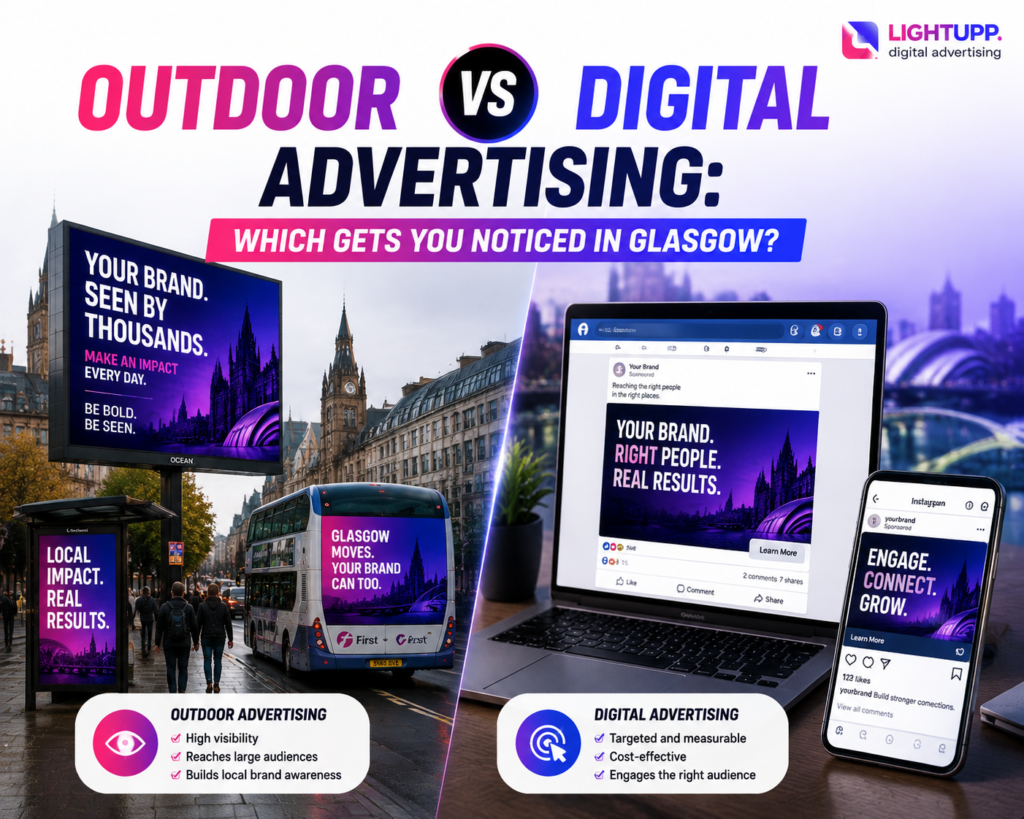
These two get compared constantly, usually badly. Digital advocates point out that outdoor can’t be tracked; outdoor advocates point out that digital gets blocked and ignored. Both are right, which tells you the comparison isn’t really about which is better. They reach people in fundamentally different states of mind, and the useful question is which state your customers are in when you need to reach them. This guide sets out what each genuinely does, where each falls down, and how to decide between them-or use both properly.
The Core Difference: Interruption vs Environment
Digital advertising reaches people who are engaged with a screen-scrolling, searching, watching. You’re competing for attention against everything else on that screen, and against a brain actively filtering most of it out.
Outdoor advertising reaches people moving through physical space-commuting, walking, waiting. You’re not competing with a feed; you’re part of the environment. Attention isn’t guaranteed, but the avoidance mechanisms people have developed online don’t apply.
That distinction drives everything else. Digital can target precisely and measure exactly, but is easy to skip. Outdoor can’t be blocked and builds familiarity through repetition, but tells you very little about who saw it.
What Digital Advertising Does Well
- Precise targeting-by location, age, interests, behaviour, and search intent
- Speed-campaigns can be live within hours and adjusted the same day
- Measurement-you can see clicks, cost per enquiry, and what’s working
- Flexibility-change the message, budget, or audience whenever you like
- Intent capture-search ads catch people at the moment they need you
Where it falls short
- It’s genuinely easy to ignore-people scroll past hundreds of ads daily
- Ad blockers and skip buttons remove you entirely for some audiences
- Results stop the moment the budget does
- Costs rise as more advertisers compete for the same audiences
- Audiences know it’s paid, so it carries less inherent credibility
If you’re weighing up which digital channel suits you, our comparison of Facebook and Google ads covers that decision specifically.
What Outdoor Advertising Does Well
- It can’t be skipped, blocked, or scrolled past
- Repetition builds familiarity-the same commuters see you daily for weeks
- It signals substance, suggesting an established business
- Geographic precision that matters for local businesses
- Reaches people who are hard or expensive to reach online
Where it falls short
- You can’t track it the way you track digital-no clean attribution
- It’s not built for immediate response; nobody stops the car to buy
- It rewards commitment rather than short tests
- The message must be extremely simple
- You can’t adjust it once it’s up
We’ve covered whether outdoor suits your business in more depth in our guide to outdoor advertising in Glasgow.
Green Flags vs Red Flags
Which one fits your situation:
| Green Flag | Red Flag |
| Digital: you need enquiries on a timeline | Digital: expecting it to build deep trust alone |
| Digital: you want to measure and optimise | Digital: ‘set and forget’ with no adjustment |
| Outdoor: building local recognition over months | Outdoor: needing results within a fortnight |
| Outdoor: your message is genuinely simple | Outdoor: your offer needs explaining |
| Outdoor: you serve a defined local area | Outdoor: customers scattered nationally |
| Either: matched to how customers find you | Either: chosen because it seemed modern or traditional |
How to Decide
Lean digital if
- You need enquiries within weeks rather than months
- Your customers search for what you offer when they need it
- You want to measure return precisely
- Your offer needs some explanation
- Your budget is modest and you want to test before committing
Lean outdoor if
- You serve a clearly defined local area
- Building recognition matters more than immediate response
- Your message is simple-a name and one idea
- You can commit to a decent run rather than a short test
- You want to reach people who ignore online advertising
Use both if
- You want recognition and response rather than one or the other
- You’re established enough to invest across a longer horizon
- Your local market is competitive enough that familiarity matters
How They Work Together
The genuinely interesting part isn’t choosing-it’s what happens when both run. Someone who’s passed your display on their commute for three weeks and then sees your ad in their feed responds differently to someone seeing either cold. The outdoor has made your name familiar; the digital ad converts that familiarity into action.
This is why the two aren’t really rivals. Outdoor creates recognition that digital can capitalise on, and digital provides the trackable response mechanism outdoor lacks. The practical sequence for most local businesses: get digital working first because it’s faster and measurable, then add outdoor once you’re established enough to invest in recognition over months.
One thing that matters when running both: they should look like the same business. A display and a social ad that share nothing visually are two separate impressions rather than two reinforcing ones.
Why Glasgow Businesses Choose LightUpp
We run both, which is precisely why we can be straight about the comparison rather than advocating for whichever we happen to sell. If you need enquiries next month, outdoor is the wrong tool and we’ll say so. If you’re competing locally and nobody recognises your name, digital alone will keep costing you more than it should. Because outdoor, paid advertising, social and branding sit with one team, what appears on a display and what appears in a feed look like the same business. More at lightupp.co.uk.
Frequently Asked Questions
Is outdoor advertising better than digital?
Neither is better in the abstract-they reach people in different states. Digital targets precisely and measures exactly but is easy to ignore; outdoor can’t be skipped and builds familiarity but tells you little about who saw it. The right choice depends on whether you need response or recognition.
Can I run outdoor and digital advertising at the same time?
Yes, and they complement each other well. Outdoor builds the familiarity that makes digital ads more effective, while digital provides the trackable response outdoor can’t. The important thing is that both look like the same business.
Which should a small local business start with?
Usually digital, because it’s faster, cheaper to test, and measurable-which matters when budgets are tight. Outdoor tends to make more sense once you’re established and want recognition across months rather than enquiries this week.
How do I measure outdoor advertising against digital?
You can’t compare them on the same terms, honestly. Digital gives you cost per click and per enquiry; outdoor gives you proxies like changes in brand searches, enquiry volume, and asking customers how they heard of you. Expecting identical metrics from both leads to unfair comparisons.
Related Reading
To go deeper on either side:
- Outdoor Advertising in Glasgow: Does It Still Work for Local Businesses?-whether outdoor suits your business-https://lightupp.co.uk/outdoor-advertising-in-glasgow-does-it-still-work-for-local-businesses/
- Facebook Ads vs Google Ads: Which Should Local Businesses Try First?-choosing between the main digital options-https://lightupp.co.uk/facebook-ads-vs-google-ads-which-should-local-businesses-try-first/
- Advertising in Glasgow: Which Type of Advertising Works Best for Local Businesses?-the full range of advertising options locally-https://lightupp.co.uk/advertising-in-glasgow-which-type-of-advertising-works-best-for-local-businesses/


