



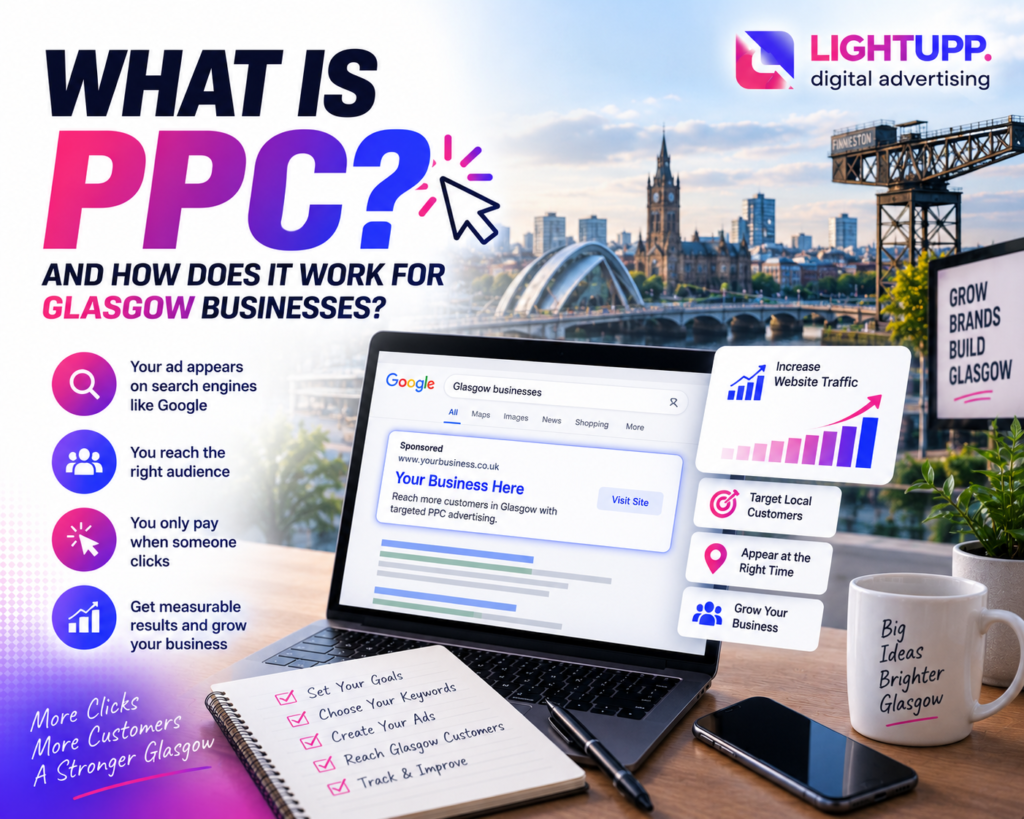
PPC is one of those acronyms that gets used as though everyone already knows it. If you’ve been told you should be doing PPC, or you’ve seen it on an agency’s service list and nodded along, this is the explanation without the jargon: what it actually is, how the money works, what it realistically delivers for a local business, and the situations where it isn’t worth your money.
What PPC Actually Means
PPC stands for pay-per-click. It’s advertising where you pay only when someone clicks your ad- not when it’s shown. If a thousand people see your ad and nobody clicks, you pay nothing. If ten click, you pay for ten clicks.
The most common form is search advertising: someone types something into Google, and paid results appear above the ordinary listings. But the model also covers paid social, display advertising, and shopping ads.
The appeal for a local business is straightforward- you’re paying for actual visits rather than for being seen, and you can be in front of someone at the precise moment they’re looking for what you sell.
How the Money Actually Works
This is the part that confuses people, and it’s worth understanding before you spend anything.
It’s an auction, but not a simple one
You tell the platform the most you’ll pay for a click. So does everyone else advertising for that term. But the highest bid doesn’t automatically win- the platforms also weigh how relevant and useful your ad is likely to be. A well-targeted ad with a relevant landing page can outrank a higher bid from a worse-matched competitor.
The practical consequence: getting the setup right can genuinely cost you less than outbidding people. Relevance is a lever, not just budget.
What you actually pay
- You set a daily or monthly budget the platform won’t exceed
- You’re charged per click, at a rate that varies by how competitive the term is
- Competitive commercial terms cost considerably more per click than niche ones
- An agency’s management fee sits on top of this and should be stated separately
Always be clear which portion of what you’re paying is media spend and which is fee. Vagueness there is a warning sign.
Where PPC Works Well
- Urgent services- plumbers, locksmiths, electricians, anything people need now
- Businesses where customers actively search for what you offer
- Testing demand quickly before committing to slower channels
- Filling gaps when organic visibility is weak or still building
- Reaching people at the moment of intent rather than interrupting them
That first point is why PPC suits trades particularly well- someone with a burst pipe searches and calls whoever appears. We’ve covered that specific case in our guide to marketing for trades.
Where PPC Falls Short
- It stops the moment you stop paying- there’s no residual benefit
- Competitive terms can cost more per click than the lead is worth
- It’s easy to waste money without proper setup and ongoing attention
- It rewards optimisation; ‘set and forget’ campaigns quietly underperform
- A weak landing page or slow response undoes good campaigns entirely
- Small budgets may not generate enough data to learn from
The most common failure isn’t the platform- it’s pointing well-targeted traffic at a page that doesn’t convert, or letting enquiries sit unanswered. PPC amplifies whatever you send people to.
Green Flags vs Red Flags
Signs your PPC is set up properly- or isn’t:
| Green Flag | Red Flag |
| You own the ad account outright | Campaigns run from an agency’s account |
| Conversion tracking properly configured | No idea which clicks became enquiries |
| Ads point to a matching, relevant page | All ads land on the homepage |
| Negative keywords filtering waste | Paying for irrelevant searches |
| Regular optimisation and adjustment | Campaign untouched since launch |
| Reporting on cost per enquiry | Reporting on clicks and impressions only |
| Fee and media spend stated separately | One combined figure with no breakdown |
The Setup Details That Decide Whether It Works
Most PPC that fails, fails on these rather than on strategy:
- Negative keywords- telling the platform which searches to exclude, so you’re not paying for people looking for something else entirely
- Location targeting- set tightly to your actual service area, not a generous radius
- Landing pages matching the ad- someone who clicked an ad about one service shouldn’t land on a general homepage
- Conversion tracking- without it you’re guessing which spend produced results
- Ad extensions- the extra links, phone number, and location that make your listing larger and more clickable
None of these are exotic. They’re the difference between PPC that works and PPC that quietly drains budget, and they’re the first things worth auditing if a campaign isn’t performing.
Is PPC Right for Your Business?
It tends to suit businesses whose customers actively search, who need results on a defined timeline, and who can point clicks at something that converts. It’s a weaker fit if nobody searches for what you offer, if your margins can’t absorb competitive click costs, or if the basics- a decent website, fast responses- aren’t in place yet.
For most local businesses the sensible order is: get your Google Business Profile and reviews sorted first, since those are free and improve everything downstream, then add PPC once there’s something solid for the clicks to land on.
Why Glasgow Businesses Choose LightUpp
PPC done properly is unglamorous, ongoing work- checking search terms, adding negatives, adjusting bids, testing ad copy. LightUpp handles that alongside your social media, branding and outdoor, so campaigns point at pages and profiles that actually match what the ad promised. Clients keep full ownership of their ad accounts, and if your budget would work harder on something other than PPC, we’ll say so. More at lightupp.co.uk/online-ads/.
Frequently Asked Questions
What does PPC stand for?
Pay-per-click- advertising where you’re charged when someone clicks your ad rather than when it’s displayed. It covers paid search, paid social, shopping and display advertising.
Is PPC the same as Google Ads?
Google Ads is the largest PPC platform but not the only one. Facebook, Instagram, LinkedIn and others all operate on the same pay-per-click model, so PPC is the broader category and Google Ads sits within it.
How much should I spend on PPC to start?
Enough to generate meaningful data, which varies by how competitive your terms are. Too little and the campaign never gathers enough information to optimise, so it underperforms and gets abandoned. A good agency will tell you honestly if your budget is below a workable floor.
Why is my PPC not producing enquiries?
Usually targeting that’s too broad, missing negative keywords, or ads pointing at a page that doesn’t match what was promised. Occasionally the campaign is fine and enquiries are arriving but not being answered quickly enough- worth ruling that out before blaming the ads.
Related Reading
To go further on paid advertising:
- Facebook Ads vs Google Ads: Which Should Local Businesses Try First?– choosing your first PPC platform- https://lightupp.co.uk/facebook-ads-vs-google-ads-which-should-local-businesses-try-first/
- The Best Paid Advertising Agencies in Scotland: What to Look for and Who to Trust– what to look for if you’d rather have it managed- https://lightupp.co.uk/the-best-paid-advertising-agencies-in-scotland-what-to-look-for-and-who-to-trust/
- Why Your Facebook and Instagram Ads Aren’t Working: 7 Fixes for Glasgow Businesses– the most common paid advertising mistakes- https://lightupp.co.uk/why-your-facebook-and-instagram-ads-arent-working-7-fixes-for-glasgow-businesses/


