



Most businesses that say they want branding actually mean a new logo, some colours, and maybe a refreshed website. That’s the visible part- and it’s important. But underneath it sits something most small businesses skip entirely: brand strategy, the thinking that decides what all that visual work is supposed to communicate. When the strategy is missing, the result is often a brand that looks polished but says nothing in particular. This guide explains the difference, why the order matters, and how to tell whether your business is missing the strategic half.
The Difference, Plainly
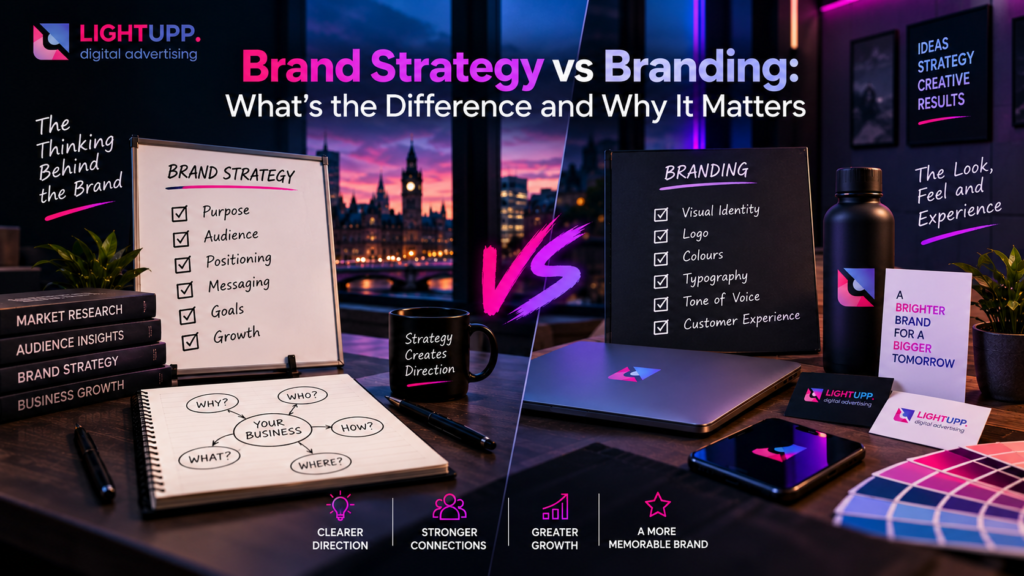
- Brand strategy is the thinking: who you’re for, what you stand for, how you’re different, and how you want to be perceived.
- Branding is the expression: the logo, colours, typography, imagery, and tone of voice that communicate that thinking.
Strategy decides what to say; branding decides how it looks and sounds. A useful comparison is a building- strategy is the foundation and floor plan, branding is the finish and furnishing. You can make a building look lovely without a plan, but it won’t necessarily work for the people using it.
It’s also different again from marketing, which is about getting the brand in front of people. If you’re untangling those terms, branding agency vs marketing agency https://lightupp.co.uk/branding-agency-vs-marketing-agency-whats-the-difference-and-which-do-you-need/ covers where each one sits.
What Brand Strategy Actually Covers
Your audience
Specifically who you’re trying to reach- not “everyone who needs this”, but the customers you’re best placed to serve and most want more of.
Your positioning
Where you sit relative to competitors. Premium or accessible, specialist or broad, traditional or modern. Positioning is what gives customers a reason to pick you rather than the alternative down the road.
What makes you different
The genuine reasons someone should choose you. Not claims every competitor also makes- “quality service”, “friendly team”- but the things that are actually true of you and not of them.
Your personality and voice
How the business comes across: formal or relaxed, expert or approachable, bold or reassuring. This shapes everything from website copy to social captions.
Your core message
The one thing you want people to understand and remember about you. Everything else in your marketing should reinforce it.
Why Strategy Should Come First
When businesses jump straight to visuals, a few predictable problems follow:
- The logo gets judged on personal taste, because there’s no brief to judge it against
- The brand looks professional but could belong to any business in the sector
- Different pieces of marketing say different things, because nobody agreed what the message was
- Decisions get revisited endlessly, since there’s no agreed direction to settle them
Strategy gives the visual work something to aim at. It’s the difference between a logo that simply looks good and one that does its job- the distinction we explore in what a good logo actually needs to do https://lightupp.co.uk/logo-design-in-glasgow-what-a-good-logo-actually-needs-to-do/.
Signs Your Business Is Missing Brand Strategy
- You struggle to explain in one sentence why a customer should choose you
- Your website, social media and printed materials all describe you differently
- You compete mainly on price because there’s no other clear reason to pick you
- Your brand looks similar to your competitors’
- Every new piece of marketing starts from scratch with no clear direction
- Staff describe the business differently from each other
If several of these sound familiar, the gap probably isn’t your logo- it’s the thinking behind it.
Green Flags vs Red Flags
| Green Flag | Red Flag |
| You can say why customers should choose you in one sentence | ‘We offer quality service’- like everyone else |
| Every channel carries the same core message | Website, social and print all say different things |
| Visual choices are judged against a brief | Logo chosen purely on personal taste |
| Clear audience you’re built for | Aimed at ‘anyone who needs this’ |
| You compete on something other than price | Price is the only differentiator |
| Strategy agreed before design begins | Designing first, deciding later |
Does a Small Business Really Need This?
It doesn’t need to be a lengthy or expensive exercise. For a small business, brand strategy can be a focused piece of work that produces a page or two of clear decisions- who you’re for, how you’re different, how you sound, and what you want people to remember. That page then guides every piece of design and marketing that follows.
What it shouldn’t be is skipped. A small business with a clear strategy and a simple logo will usually outperform one with a beautiful logo and no clear idea of what it’s trying to say.
Strategy Before a Rebrand
If you’re considering a rebrand, strategy matters even more. Many rebrands fail because they change the look without changing- or clarifying- the thinking, so the business ends up with new visuals and the same underlying problem. Before committing, it’s worth reading signs your business needs a rebrand (and signs it doesn’t) https://lightupp.co.uk/signs-your-business-needs-a-rebrand-and-signs-it-doesnt/, which covers when a strategic refresh would serve you better than a new identity.
From Strategy to Everything Else
Once the strategy is agreed, it flows into the visible work- your brand identity and logo https://lightupp.co.uk/branding/brand-identity-logo-design/, your marketing materials https://lightupp.co.uk/branding/marketing-material/, and your website design https://lightupp.co.uk/branding/website-design/. The point of doing strategy first is that each of these then says the same thing, which is what makes a brand recognisable rather than just attractive.
Why Glasgow Businesses Choose LightUpp
Our brand strategy https://lightupp.co.uk/branding/brand-strategy/ work is deliberately practical: a clear set of decisions a small business can actually use, not a thick document that sits in a drawer. Because strategy, design, social media and advertising sit with one team, the thinking carries through into everything your customers see. If you’ve got a clear strategy already and just need the visual work, we’ll say so. More about how we work at LightUpp https://lightupp.co.uk/.
Frequently Asked Questions
What’s the difference between brand strategy and branding?
Brand strategy is the thinking- your audience, positioning, what makes you different, and how you want to be seen. Branding is how that thinking is expressed through your logo, colours, typography and tone of voice. Strategy decides what to say; branding decides how it looks and sounds.
Do I need brand strategy before a new logo?
Ideally, yes. Without it, a logo gets judged on personal taste rather than whether it communicates the right thing. Even a short strategy exercise gives the design work a clear brief to aim at.
Is brand strategy only for big companies?
No. For a small business it can be a focused exercise that produces a page or two of clear decisions. What matters is that the thinking happens, not how elaborate the document is.
How do I know if my brand strategy is working?
If you can explain in one sentence why customers should choose you, and your website, social media and materials all say the same thing, it’s working. If every channel describes you differently, the strategy is either missing or not being used.
Related Reading
- Logo Design in Glasgow: What a Good Logo Actually Needs to Do– turning strategy into a logo- https://lightupp.co.uk/logo-design-in-glasgow-what-a-good-logo-actually-needs-to-do/
- Signs Your Business Needs a Rebrand (and Signs It Doesn’t)– when strategy matters most- https://lightupp.co.uk/signs-your-business-needs-a-rebrand-and-signs-it-doesnt/
- The Best Branding & Design Studios in Glasgow: What to Look for and Who to Trust– choosing who to work with- https://lightupp.co.uk/the-best-branding-design-studios-in-glasgow-what-to-look-for-and-who-to-trust/


