



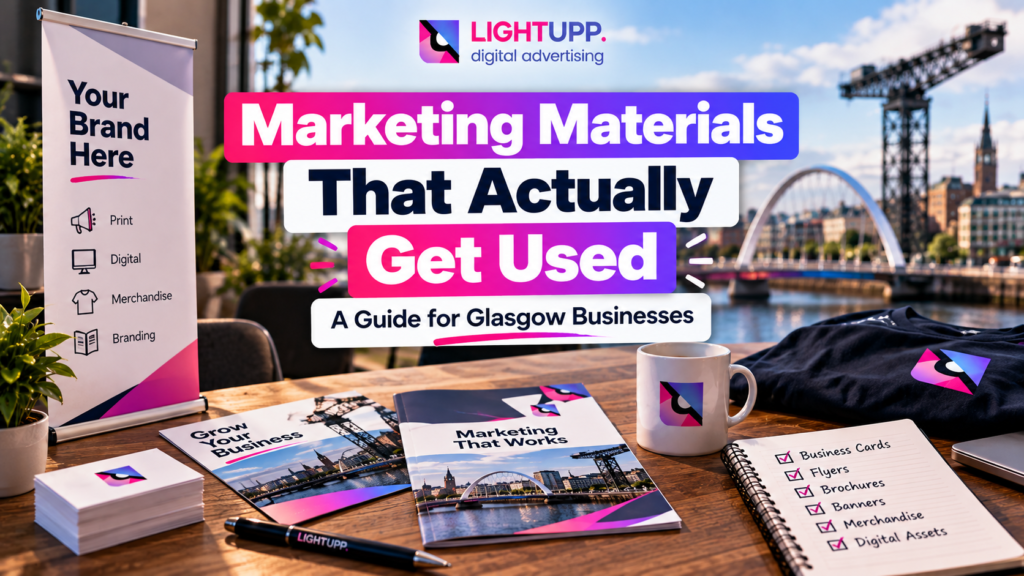
Most businesses have a drawer somewhere full of brochures nobody asked for and business cards from a logo they’ve since changed. Marketing materials are easy to order and surprisingly easy to waste. The ones that earn their cost share a few traits: they’re made for a specific moment, they look like the rest of the business, and they give the person holding them something useful to do next. This guide covers what those materials are, which ones matter for a Glasgow business, and how to avoid paying for print that goes straight in the bin.
What Counts as Marketing Material
It’s broader than print. Anything a customer might hold, read, or be handed that represents your business counts:
- Business cards and letterheads
- Brochures, flyers and leaflets
- Price lists, menus and service sheets
- Presentation and proposal templates
- Signage, banners and exhibition stands
- Social media templates and email signatures
The digital pieces often matter more than the printed ones now, because customers see them far more often. A consistent social template or proposal layout does more work across a year than a single brochure print run.
Start With the Moment, Not the Format
The most common mistake is deciding “we need a brochure” before deciding when anyone would read it. Better to start from the moments where a customer needs something in their hands:
- After a first meeting- something that reminds them who you are and what you offer
- At the point of sale- a clear price list or menu that answers questions quickly
- At an event- something memorable that survives the journey home
- When they’re comparing quotes- a proposal that looks more organised than the competition’s
Once you know the moment, the right format usually becomes obvious- and so does which materials you don’t actually need.
What Makes Materials Actually Get Used
They look like the rest of your brand
A flyer that uses different colours or an old logo tells customers the business is disorganised. Every piece should match your website, social profiles and signage. That consistency is what the half-second test https://lightupp.co.uk/the-half-second-test-why-branding-decides-whether-glasgow-customers-notice-you/ is really about- people recognise you before they read a word.
They say one thing clearly
A leaflet trying to cover every service ends up communicating none of them. One clear offer or message, with supporting detail kept brief, will be remembered. Everything else can live on your website.
They tell people what to do next
Every piece should end with an obvious next step- a phone number, a web address, a QR code to a booking page. Materials without a next step become decoration.
They’re worth keeping
Useful content survives. A price guide, a checklist, a seasonal offer with a date, or genuinely helpful information gets kept on the fridge or the desk. A list of company values rarely does.
The Essentials Most Businesses Need
- Business cards- still expected in many trades and B2B settings
- A one-page service or price sheet- the single most useful document for most local businesses
- Social media templates- so posts stay on-brand without starting from scratch
- A proposal or quote template- makes you look organised when customers compare options
- Email signature- seen more often than almost anything else you produce
Brochures, exhibition stands and large print runs are worth it for some businesses, but they should come after the essentials, not before.
Green Flags vs Red Flags
| Green Flag | Red Flag |
| Made for a specific moment | Printed because ‘we should have a brochure’ |
| Matches your logo, colours and tone | Old logo or mismatched colours |
| One clear message | Every service crammed in |
| Obvious next step or QR code | No way to act on it |
| Small, updatable print runs | 5,000 copies that date in six months |
| Editable templates you own | Only flattened files from the designer |
Print Smaller, Update More Often
Large print runs look economical until prices change, a service is added, or the phone number moves. Shorter runs cost more per copy but less in waste, and they let you update materials as the business changes. The same goes for digital templates- keep editable versions so small changes don’t need a designer every time.
Materials Are Part of Your Brand, Not an Extra
Marketing materials work best when they come out of a clear brand rather than being designed one at a time. If you haven’t settled what your business stands for and how it should sound, brand strategy vs branding https://lightupp.co.uk/brand-strategy-vs-branding-whats-the-difference-and-why-it-matters/ explains why that thinking comes first, and what a good logo needs to do https://lightupp.co.uk/logo-design-in-glasgow-what-a-good-logo-actually-needs-to-do/ covers the mark that sits on every piece.
Why Glasgow Businesses Choose LightUpp
Our marketing material https://lightupp.co.uk/branding/marketing-material/ work starts with where each piece will be used, not with a template. Because it sits alongside branding https://lightupp.co.uk/branding/, social media and advertising with one team, everything from your business card to your social templates looks like the same business. You get editable files you own. More about how we work at LightUpp https://lightupp.co.uk/.
Frequently Asked Questions
Do small businesses still need printed marketing materials?
Many do, especially trades, hospitality and anyone meeting customers face to face. But most get more value from a clear price sheet and consistent digital templates than from a large brochure run.
What’s the most useful piece of marketing material?
For most local businesses, a one-page service or price sheet. It answers the questions customers actually ask and works printed, emailed, or shared as a PDF.
How many should I print?
Fewer than you think. Short runs cost more per copy but waste far less when details change. Only print large quantities of materials that won’t date.
Should my materials match my website?
Yes, always. The same logo, colours, fonts and tone across print and digital is what makes a business recognisable and trustworthy.
Related Reading
- Brand Strategy vs Branding: What’s the Difference and Why It Matters– deciding what your materials should say- https://lightupp.co.uk/brand-strategy-vs-branding-whats-the-difference-and-why-it-matters/
- Logo Design in Glasgow: What a Good Logo Actually Needs to Do– the mark on every piece- https://lightupp.co.uk/logo-design-in-glasgow-what-a-good-logo-actually-needs-to-do/
- The Half-Second Test: Why Branding Decides Whether Glasgow Customers Notice You– why consistency matters- https://lightupp.co.uk/the-half-second-test-why-branding-decides-whether-glasgow-customers-notice-you/


