



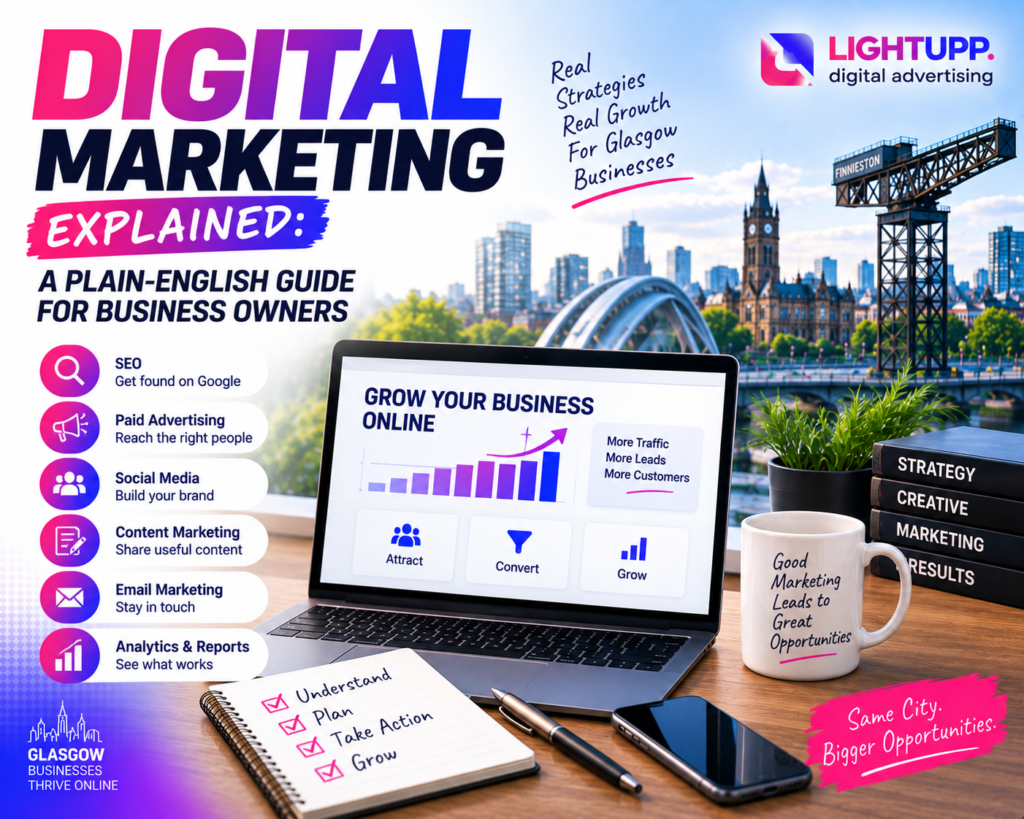
Digital marketing is a term that covers so much it’s almost meaningless. It includes everything from a Facebook post to a technical website audit, which makes it genuinely hard to know what people mean when they use it – or what you’d actually be buying. This guide takes it apart: what each piece does, how they fit together, which ones matter for a small business, and which you can reasonably ignore. No jargon, and no pretending everything is essential.
What It Actually Means
Digital marketing is any marketing that happens online. That’s the whole definition — it’s a category, not a technique, which is why the term on its own tells you very little.
What’s more useful is understanding that everything under the heading does one of three jobs:
- Getting found – being visible when people look for what you offer
- Being chosen – looking credible enough that people pick you
- Staying in mind – remaining visible so people return or remember you
Almost every digital marketing activity serves one of those. When someone recommends a tactic, the useful question is which of the three it addresses – and whether that’s actually your weak spot.
The Main Channels, Explained Simply
Search – being found when people look
Covers both paid search (ads at the top of results) and SEO (earning ordinary listings). The advantage of search is intent – you’re reaching people at the moment they’re actively looking, which is the most valuable moment there is.
For local businesses, the map results driven by your Google Business Profile matter enormously here, and they’re free.
Social media – being seen and building familiarity
Organic posting keeps you visible and credible to people who already know you. Paid social reaches new people who weren’t looking. They do different jobs, which is why treating them as one thing leads to disappointment on both counts.
Your website – where decisions get made
Everything else sends people here, which makes it the point where interest either converts or evaporates. A clear, fast site that works on a phone does more than most people credit; a confusing one quietly wastes everything upstream of it. If yours is the weak link, that’s a website design problem rather than a traffic one.
Email – staying in touch with people who know you
Unfashionable and consistently effective. It reaches people who’ve already shown interest, costs little, and isn’t dependent on a platform’s algorithm.
Video – showing rather than telling
Increasingly where attention sits. Works across social, ads, and your website, and it’s the format most businesses find hardest to produce consistently, which makes it the one most worth outsourcing – see promo video production.
Display and retargeting – following up
Ads shown to people who’ve already visited your site. Useful for staying in mind, though easy to overdo to the point of irritation.
How They Fit Together
The mistake most businesses make is treating these as separate activities to tick off. They work as a sequence:
- Search and paid social bring people who don’t know you
- Your website and social profiles convince them you’re worth choosing
- Email and organic social keep you in mind afterwards
- Retargeting catches those who looked but didn’t act
A weakness anywhere in that chain undermines everything else. Excellent ads pointing at a poor website waste money; a brilliant website nobody finds does nothing. We’ve set out how this sequence works in more detail in our guide to marketing funnels.
Green Flags vs Red Flags
Signs your digital marketing is set up sensibly:
| Green Flag | Red Flag |
|---|---|
| Channels chosen for how customers find you | Doing everything because you feel you should |
| Website converts the traffic you send it | Traffic arrives and nothing happens |
| A few channels done consistently | Many channels done sporadically |
| You know where enquiries come from | No idea what’s actually working |
| Google Business Profile active | Free local visibility left unused |
| Each activity has a clear purpose | Activity for its own sake |
What Actually Matters for a Small Business
Not everything on this list deserves your attention. If you’re a local business with limited time, the honest priority order is:
- Google Business Profile – free, fast, and the biggest local lever there is
- Reviews – they affect both visibility and whether people choose you
- A website that works properly on a phone
- One or two social channels, kept genuinely current
- Paid advertising, once the above are working
- Everything else, only if there’s a specific reason
Most businesses would get more from doing the first three properly than from adding another channel. The temptation is always to add rather than to improve, and it’s usually the wrong instinct.
The Jargon, Translated
- SEO – making your site more likely to appear in ordinary search results
- PPC – advertising where you pay per click rather than per view
- CTR – the percentage of people who see something and click it
- Conversion – someone taking the action you wanted, like enquiring
- Organic – results or reach you didn’t pay for
- Retargeting – showing ads to people who’ve already visited you
- Impressions – how many times something was displayed, not how many people saw it properly
A reasonable rule when dealing with anyone selling to you: if they can’t explain a term in plain English, they either don’t understand it themselves or are relying on you not asking.
Why Glasgow Businesses Choose LightUpp
Most of the value in digital marketing comes from doing a few things consistently rather than everything occasionally – and knowing which few. LightUpp covers social media, paid advertising, branding, video and outdoor with one team, so the channels support each other instead of running as disconnected activity. We’ll also tell you which parts you don’t need, which tends to be more of them than people expect. See the full range of services, or start from the homepage.
Frequently Asked Questions
What does digital marketing actually include?
Any marketing that happens online – search, social media, your website, email, video, and online advertising. It’s a category rather than a technique, which is why the term alone tells you very little about what you’d be buying.
Which digital marketing channel should a small business start with?
For most local businesses, the Google Business Profile and reviews. Both are free, both work quickly, and both improve the return on anything you pay for later. Adding paid channels before those are sorted usually wastes money.
Do I need to be on every channel?
No, and trying to be is one of the most common mistakes. A couple of channels maintained consistently will outperform five done sporadically, because a neglected presence actively undermines credibility rather than being neutral.
How do I know if my digital marketing is working?
Track where enquiries come from – ask customers if you don’t know. Without that, you’re guessing which activity deserves more effort, and the loudest channel usually gets credit rather than the effective one.
Related Reading
To go deeper on any of the above:
- What Is a Marketing Funnel? How Glasgow Businesses Turn Followers into Customers – how the channels connect into a sequence
- Google Business Profile for Glasgow Businesses: Why It Matters and How to Get It Right – the first thing worth sorting
- How to Build a Marketing Strategy for Your Small Business (Without Overcomplicating It) – deciding what to do and what to skip


